1849 $5 Norris, Gregg & Norris Plain Edge MS(PCGS#10279)
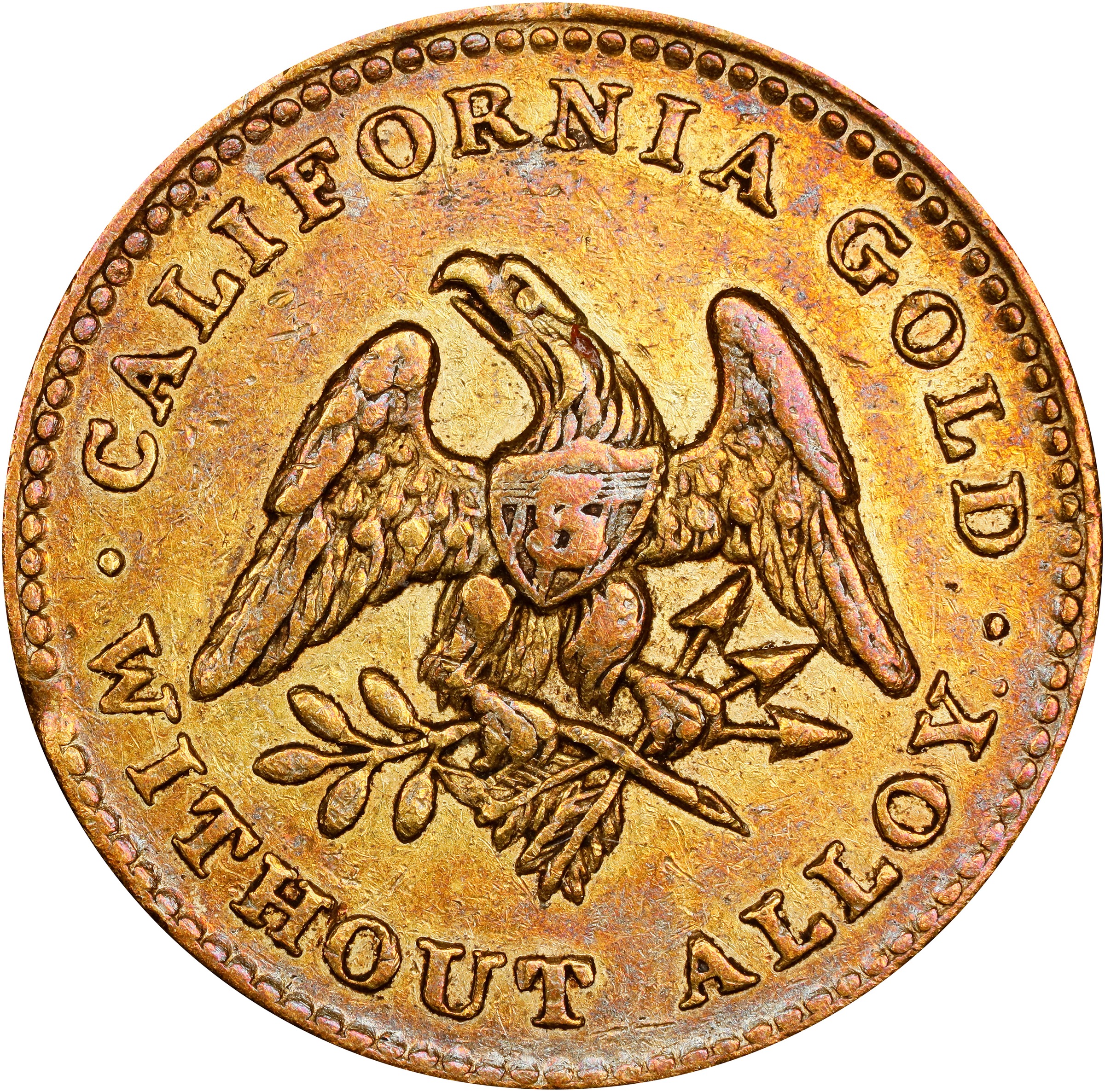
1849 $5 Norris, Gregg & Norris Plain Edge MS (PCGS#10279)
February 2026 Showcase Auction - The James A. Stack, Sr. Collection Part II
- Auctioneer
- Stack's Bowers
- Lot Number
- 23048
- Grade
- AU50+
- Price
- 52,800
- Lot Description
- Splendid rose and violet shades intermingle across the deep yellow gold surfaces of both sides. While Norris, Gregg, and Norris $5 coins all share a composition that makes them sometimes tone beautifully, this piece is even prettier than usual for the grade, with great color, no substantial defects, and superlative overall visual appeal. The surfaces show far fewer marks than usually encountered, none of which are even worthy of individual mention. A couple of lint marks, one rather long and curly, are seen on either side of F of OF near 3 o'clock on the reverse.<p><p>This is an exceptionally great looking coin, but its provenance may be even better. James A. Stack, Sr. acquired this coin from Wayte Raymond, who had recently acquired the entire collection of Hillyer Ryder. Ryder bought this coin at auction in what would be its final auction appearance for over a century, Elder's sale of October 1916. Elder's catalog covers were typically austere affairs, but the wrappers of that sale named its lead consignor: "The John G. Kellogg and Other Collections." The second day's sale began with an impressive run of territorial gold coins, headlined by a "GROUP OF FINE AND RARE PRIVATE AMERICAN GOLD COINS / Left by the Late John Glover Kellogg, of the Coining Firm of Kellog [sic] & Co." The selection consisted of a gem 1854 Kellogg $20, a Mint State Humbert $50, a Mormon $20, a Proof 1852 Humbert $20, a Proof 1852 Moffat $10, "one of the best known" 1849 Oregon $5s, and one other: the presently offered coin. If any one of us owned only seven territorial gold coins, what a seven those would be!<p><p>Elder occasionally bragged that he could catalog 1,000 lots a day. Apparently he did so with a lot of copy and pasting, as the description for this coin in his 1916 sale is cribbed word for word, abbreviation for abbreviation, without any alteration, from the description of the coin in the 1907 Chapman brothers sale of the Stickney Collection. In so copying, Elder characterized this coin as a reeded edge, which it is not. Fortunately, we have an unbroken provenance chain back to the sale, and thus back to Kellogg's personal collection, to prove this is the coin in question.<p><p>The fact that this was Kellogg's coin should be enough for most specialists to sit up and take notice, but this coin's superlative visual appeal is rather desirable as well.