1792 1C Washington, Getz Pattern Small Eagle, Plain Edge, BN MS(PCGS#921)
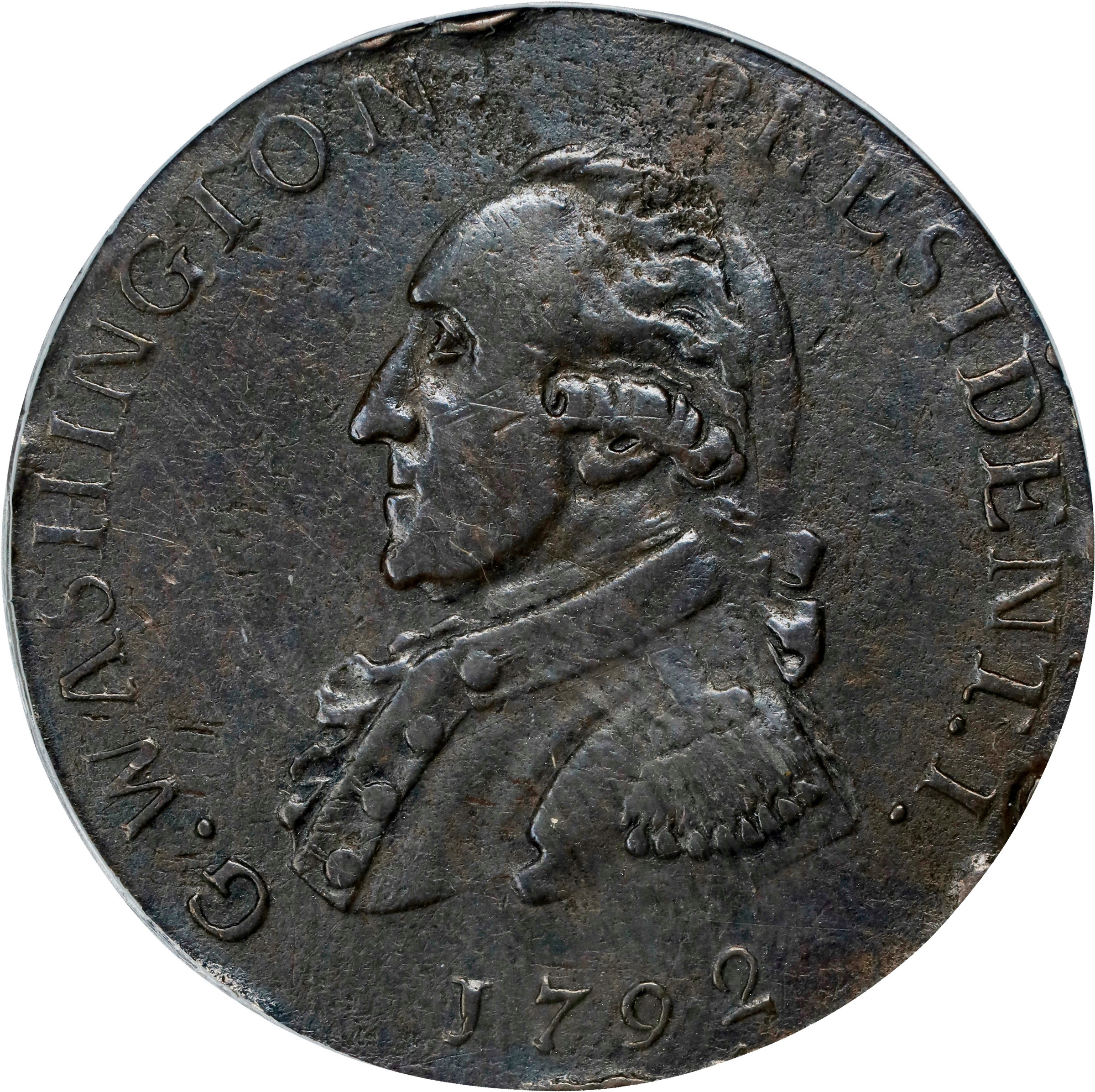
1792 1C Washington, Getz Pattern Small Eagle, Plain Edge, BN MS (PCGS#921)
Summer 2026 Global Showcase Auction U.S. Coins
- Auctioneer
- Stack's Bowers
- Lot Number
- 1357
- Grade
- VF30BN
- Price
- 9,760
- Lot Description
- A well above average specimen of this rarity from the dawn of the United States Mint. Even and appealing medium brown surfaces showcase a wealth of detail on both sides. A glass reveals some fine granularity across the surfaces, and several rim bumps and bruises are seen around the circumference. The most significant of the bruises is beneath the arrow talon on the reverse, but each side shows a couple of notable ones. Two light edge cuts are barely visible atop the obverse, mostly obscured by the holder. The surfaces show scattered marks and fine old scratches, and some hairlines are seen on the cheek, but the overall aesthetic appeal is quite nice for one of these. The population of Getz patterns is heavily weighted at lower grades, with a surprising number of (very expensive) high grade survivors known, but relatively few in the appealing middle circulated grades. Only six of these have been graded in the VF range by PCGS. This piece shows full legends, a bold date, and excellent detail on the central devices of both sides.<p>In April 1792, the Congress sent off a Mint Act for President Washington's signature. It was essentially the House version of the bill, insisting that American coins depict "an impression emblematic of Liberty." The Senate version of the bill, which never saw the president's desk, was much different, and Washington's opposition to the concepts therein may have helped kill it. By the terms of the Senate version, United States coins would have depicted:<p><em>An impression or representation of the head of the President of the United States for the time being, with an inscription which shall express the initial or first letter of his Christian or first name, and his surname at length, the succession of the presidency numerically, and the year of the coinage; and upon the reverse of each of the gold and silver coins, there shall be the figure or representation of an eagle, with this inscription - 'United States of America.'</em><p><em></em>If that design prescription sounds familiar, it is because it is precisely what appears on the Getz patterns, down to the Roman numeral I representing "the succession of the presidency numerically" that follows G. WASHINGTON PRESIDENT.<p>It appears Getz's dream of work with the United States Mint did not cease when the coinage act's language made his patterns obsolete. These dies may have been put back into use early in 1793, producing small planchet pieces whose weight intended to meet the standard for the new cent coinage. One specimen, in the Lasser Collection at Colonial Williamsburg, is overstruck on a 1794 cent. This portrait punch also created new dies: the 1796-dated die used on the unique silver "Drumheller Dollar," which also used this exact reverse die; as well as the 1797 Getz Washington Masonic medal. These dies look to have made their way into the hands of Philadelphia mechanic John Harper, whose August 1797 estate listing cites "2 Dies of General Washington Heads, 1 [ditto] of the face Masons coat of arms." The nature of Getz's relationship to Harper has yet to be uncovered.<p>George Fuld's thorough census of Getz patterns, published in 2009, listed this example as his "Number Twenty-Six" out of 53 copper pieces he encountered, 42 of which were plain edge examples. The ornamented edge seen on some specimens points to their intended use as multi-denominational patterns, as the edge imitates that seen on the Spanish colonial silver denominations familiar to Getz and his contemporaries. Though made privately, this piece's historical context is the same as the 1792 half dismes and the rarer patterns of that year, making it a prized survivor of the founding days of our national mint.