1795 $5 Small Eagle MS(PCGS#8066)
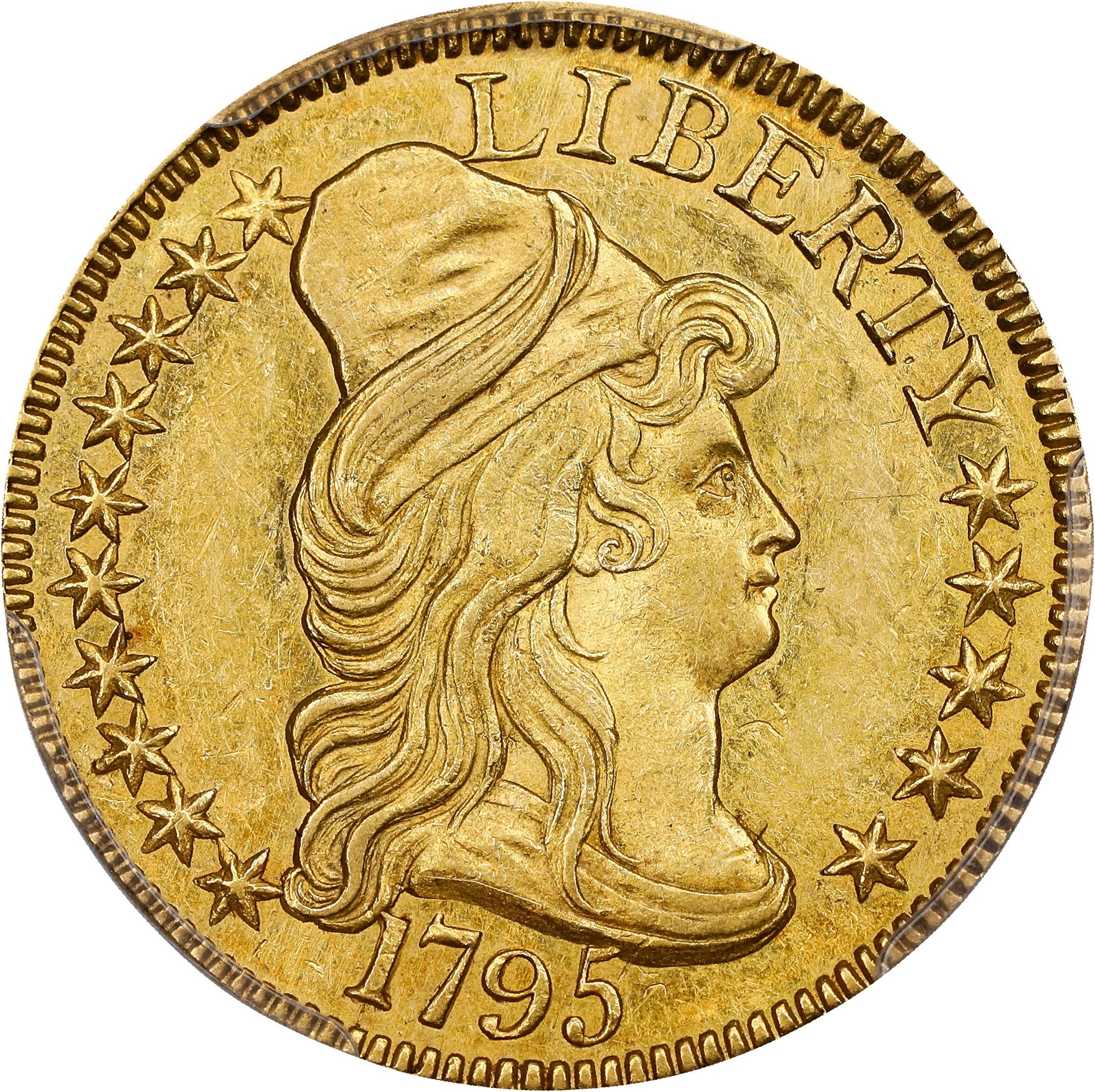
1795 $5 Small Eagle MS (PCGS#8066)
Summer 2026 Global Showcase Auction U.S. Coins
- Auctioneer
- Stack's Bowers
- Lot Number
- 2286
- Grade
- AU58
- Price
- 146,400
- Lot Description
- BD Die State a/a. An exciting numismatic discovery, one of tremendous importance to advanced collectors of pre-1834 gold coin varieties. This coin was consigned to the present Stack's Bowers Galleries auction uncertified, and with no provenance information. It was certified for the first time by PCGS ahead of this auction offering, and was identified as an example of the exceedingly rare BD-11 die pairing for the first time in the modern market by your cataloger (JLA) when preparing this description. Prior to this discovery, the only confirmed 1795 BD-11 half eagle was the Bass Core Collection specimen. Harry Bass acquired that coin from Abe Kosoff on August 14, 1972, and it has appeared in two auctions since coming back to market: Heritage's sale of the Harry W. Bass, Jr. Core Collection, Part IV, August 2023, lot 9028; Heritage's sale of the Harvey B. Jacobson, Jr. Collection of Early Half Eagles, January 2026 FUN Signature Auction, lot 1005. It appears to be the specimen plated in Robert Hilt's 1980 reference <em>Die Varieties of Early United States Coins</em>.<p>When cataloging the Bass-Jacobson specimen in January 2026, the Heritage cataloger noted that it is, "Possibly earlier from Waldo C. Newcomer and Col. E.H.R. Green." This was in reference to a notation made by Walter Breen in his 1966 monograph on early half eagle varieties: "Adams mentioned only a coin formerly owned by Guttag Bros. This may or may not be the same piece which cost Waldo Newcomer $500 VF and which was later in the Col. Green collection, illustrated by Mabbott." (Thomas Ollive Mabbott. "The Varieties of the Half Eagle of 1795", <em>Numismatic Review</em>, July 1944.) Our confirmation of the present example makes assignment of this provenance even more conjectural, as it could represent earlier numismatic ownership of the Bass-Jacobson coin, this piece, or an as-yet unconfirmed third specimen. Writing in the 2006 reference <em>Early U.S. Gold Coin Varieties: A Study of Die States, 1795-1834</em>, John W. Dannreuther reported: "Breen knew of only a single specimen and the current census stands at three." The two other coins reported to Dannreuther (besides the Bass Core Collection specimen) turned out to be misattributions of BD-12, so today we can positively confirm only two: the Bass-Jacobson coin; and the example offered here, attributed for the first time in the current market.<p>In PCGS AU-58, this coin is far finer than the Bass-Jacobson specimen, which is certified AU Details--Repaired by PCGS and was cataloged by Heritage as "likely an 'ex-jewelry' coin." Indeed, there is no comparing these two coins when it comes to either technical quality or eye appeal - this one is far finer in both categories. The vivid orange-honey surfaces glow with frosty to semi-reflective luster when rotated under lighting. The strike is ideally centered on both sides, the border denticulation complete and uniform, and all design elements sharply to fully rendered apart from a hint of softness at the central high points, read: the hair curls immediately behind Liberty's ear and the eagle's breast. There is little to report in the way of actual wear, just overall light friction that finds greatest expression in the open field areas, where most of the wispy handling marks are concentrated. None of these blemishes are sizeable enough to warrant individual attention, and one will need a loupe to fully discern two tiny nicks in the reverse field, left of the eagle's head, that we offer as identifiers to track this coin through future market appearances.<p>There are a few features that this coin shares with the Bass-Jacobson specimen - both show many of the same strike throughs on both sides. These include an irregular strike through below the letter Y in LIBERTY, a small C-shaped one in the right obverse field inside stars 12 and 13, a shallow depression low in the left obverse field at star 2, and a short, slightly curved strike through in the upper reverse field that looks like a comma following the final letter S in STATES. Clearly the culprits for these as-made features adhered to the dies at the time that both of these coins were struck, suggesting that they may have been produced close together during the press run. Not that it was a long press run, for John Dannreuther estimates that only 150 to 300 coins were struck from this die pairing.<p>The obverse die survived this brief press run, and it was brought back into use by Mint personnel in 1797 or 1798 to produce the backdated 1795 BD-15 half eagle, a rarity in its own right with just 30 to 35 pieces known, but actually the most "common" of the 1795 Heraldic Eagle varieties. Blame for the brevity of the BD-11 pairing would seem to lie with the reverse, although researchers have yet to discover exactly what damage occurred to fell that die. Given this variety's extreme rarity we may never know, and if any terminal die state coins were struck we must assume at this point that they have long since been lost to commercial use, which for pre-1834 U.S. Mint gold coins usually ended with destruction through melting. The two confirmed specimens illustrate the same die state, BD a/a, described in the 2006 Bass-Dannreuther reference as "no clashing, no lapping, no cracks" for obverse and reverse, although this is technically incorrect as both examples show a light die crack from the lower obverse border to the base of the digit 1 in the date.<p>New discoveries are always exciting for numismatists, be they industry professionals or hobbyists. Last year your cataloger discovered the fourth - and by far finest known - 1796 BB-62 Draped Bust silver dollar. A fresh-to-market coin, it was certified PCGS/CAC AU-55 ahead of our Spring 2025 Showcase Auction and soared to $90,000 in that sale. This 1795 BD-11, also fresh-to-market, and also by far the finest known for an exceedingly rare die pairing of an early U.S. Mint issue, will certainly garner just as much attention and see equally spirited bidding before finding its way into a specialized cabinet.