1799/8 1C, BN MS(PCGS#1446)
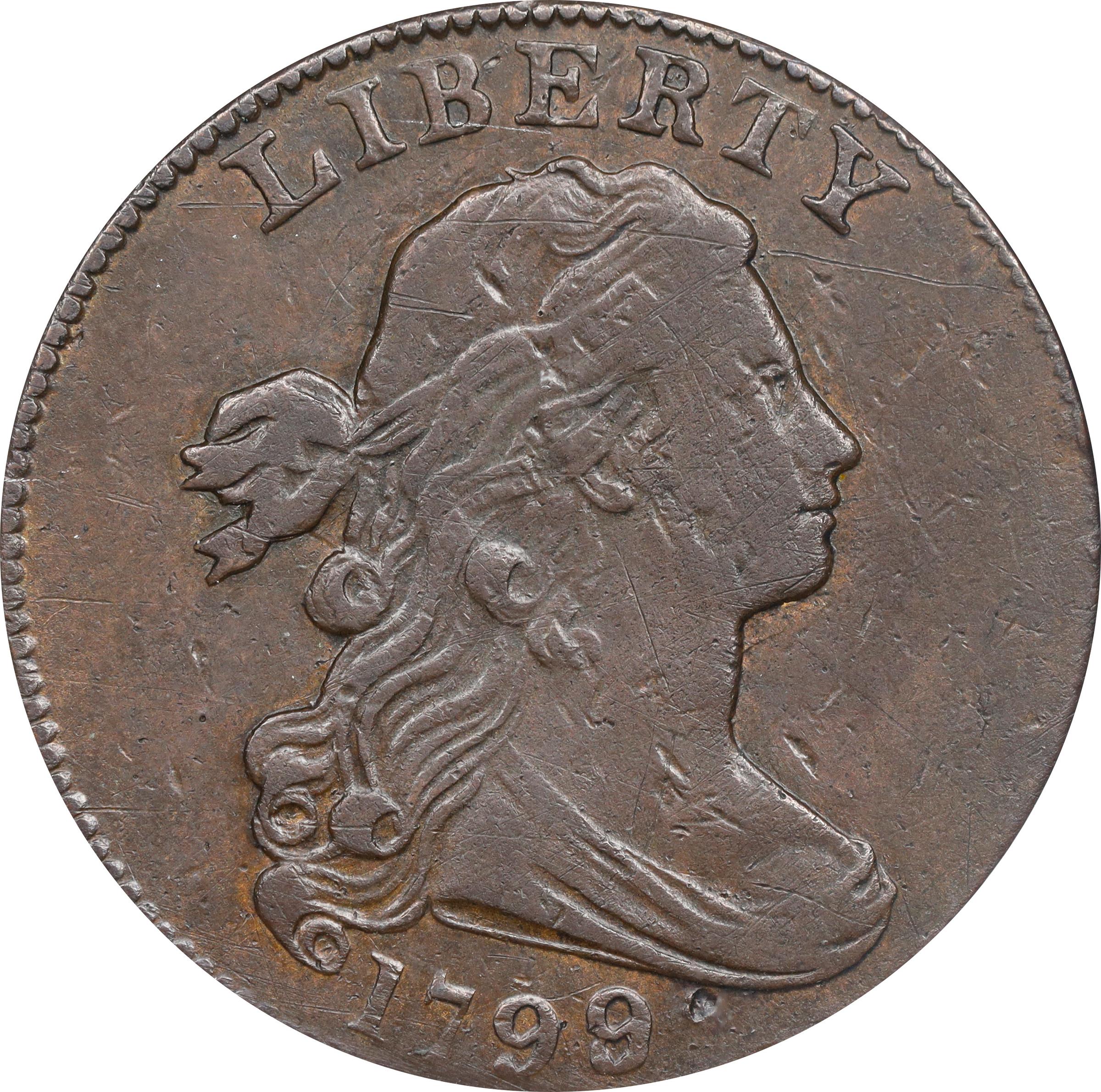
1799/8 1C, BN MS (PCGS#1446)
Summer 2025 Global Showcase Auction U.S. Coins
- 경매인
- Stack's Bowers
- 로트 번호
- 3008
- 등급
- VF25BN
- 가격
- 52,800
- 로트 설명
- One of the most famous examples of the unquestioned most famous date of the most avidly collected series in the history of American numismatics. Since before the American Civil War, collectors have pinned their greatest collecting hopes on finding a fine specimen of this coin. Joseph J. Mickley, the first to discover its rarity, made it famous, all because he was born in that year and wanted a cent from the year of his birth.<p>This one has a century-long legacy as a star of important collections, and once it's in your hand it's easy to see why. The sharpness is breathtaking for this issue, a date unknown in Mint State. The date, so often weak at its lower periphery, is complete and fully struck, including complete lower curves of the 8 under the final 9. While some American overdates require professional magnification and healthy imagination, even low magnification reveals the presence and nature of this one readily. The surfaces are mostly appealing medium chocolate brown, intermingled with rose and tan on both sides, chiefly visible at Liberty's profile and across the reverse. As expected for a circulated coin unleashed into commerce in the 18th century, some marks are seen, including a dig right of the date, a horizontal scratch from the base of the letter L in LIBERTY across the top of Liberty's head, and some worn vertical abrasions on the central reverse. A little pit is noted atop the upper right serif of the first letter T in STATES on the reverse, and a scattering of trivial marks are seen elsewhere. The visual appeal remains very strong on both sides, especially so for a cent of this regal date.<p>Key dates are relative. The 1909-S V.D.B., as famous as it is and as widely desired as it's always been, is a common coin. Nearly 23,000 have been certified by PCGS alone, and almost half that number are in Mint State grades. The 1799 cent hits a little different. The total number of Mint State coins known, including all three die marriages, is zero. Not one. PCGS has graded a 1799/8 cent on just 71 occasions in all numerical grades. So while there are three PCGS-graded 1909-S V.D.B. cents in Mint State for every county (and county equivalent) in the United States, there's not even one and a half 1799/8 cents in any grade for each state in the Union. Rarity is defined by a countable population and ease of acquisition given sufficient resources; a large population doesn't much matter if one is never obtainable. Most of the time, even with nearly infinite resources, a collector who wants a 1799/8 cent this nice will have to find solace in their personal well of patience.<p>By 1946, Louis Eliasberg had nearly every United States coin his checklist required for him to reach his ultimate goal: becoming the first collector to have a complete collection of United States coins by date and mint. He had already acquired the multigenerational Clapp holding, netting him rarities like an 1894-S dime, an 1876-CC twenty-cent piece, a 1794 dollar, and an 1815 half eagle. After more than two decades, his pursuit was closing in on completion, but a few things were still missing. He did not yet own an 1804 dollar. And he did not yet own a 1799 cent.<p>Eliasberg had a big day on June 11, 1946, because that was the day he got both.<p>William Cutler Atwater was a Brooklyn-born coal magnate. To give a sense of the scale of his business, his lawsuit against the United States Navy regarding a contract for 200,000 tons of coal ended up before the United States Supreme Court in 1923. The family cottage in Westhampton, Long Island last sold for $15 million in 2017. Before his death in 1940, the senior Atwater formed a very impressive coin collection, one B. Max Mehl characterized as including "only the very finest obtainable specimens." His greatest prize, depicted on the cover of the Atwater catalogue, was the Stickney specimen of the 1804 dollar, but he also pursued half cents and large cents vigorously. Of the 18 lots Eliasberg bought from his collection, 15 were early coppers. The others were the extremely rare 1884 and 1885 trade dollars and the 1804 dollar.<p>Among the fine coppers Eliasberg acquired that day were a 1796 No Pole half cent that brought $763,750 in our February 2016 Pogue III sale. He bought three 1793 cents from the sale: a 1793 Sheldon-1 Chain AMERI, the very first cent struck for circulation at the United States Mint, a 1793 Sheldon-4 Chain with Periods that brought $1.38 million when it sold in 2012, and a 1793 Liberty Cap cent that cost Eliasberg $2,000 but brought $319,000 when we sold it in 1996. Atwater's good taste was evident throughout Eliasberg's copper purchases, including this key 1799/8 cent and the key of the Matron Heads, the 1823, that graded Proof-64 BN (PCGS) when we sold it for $80,500 in November 2008, still a record for the issue.<p>The character of coins, like people, can often be estimated by the company they keep. This rare cent has been surrounded by some of the most important coins ever over the course of its lifespan as a collectible. We expect that tradition to continue when it sells here.