1861-O $20 MS(PCGS#8934)
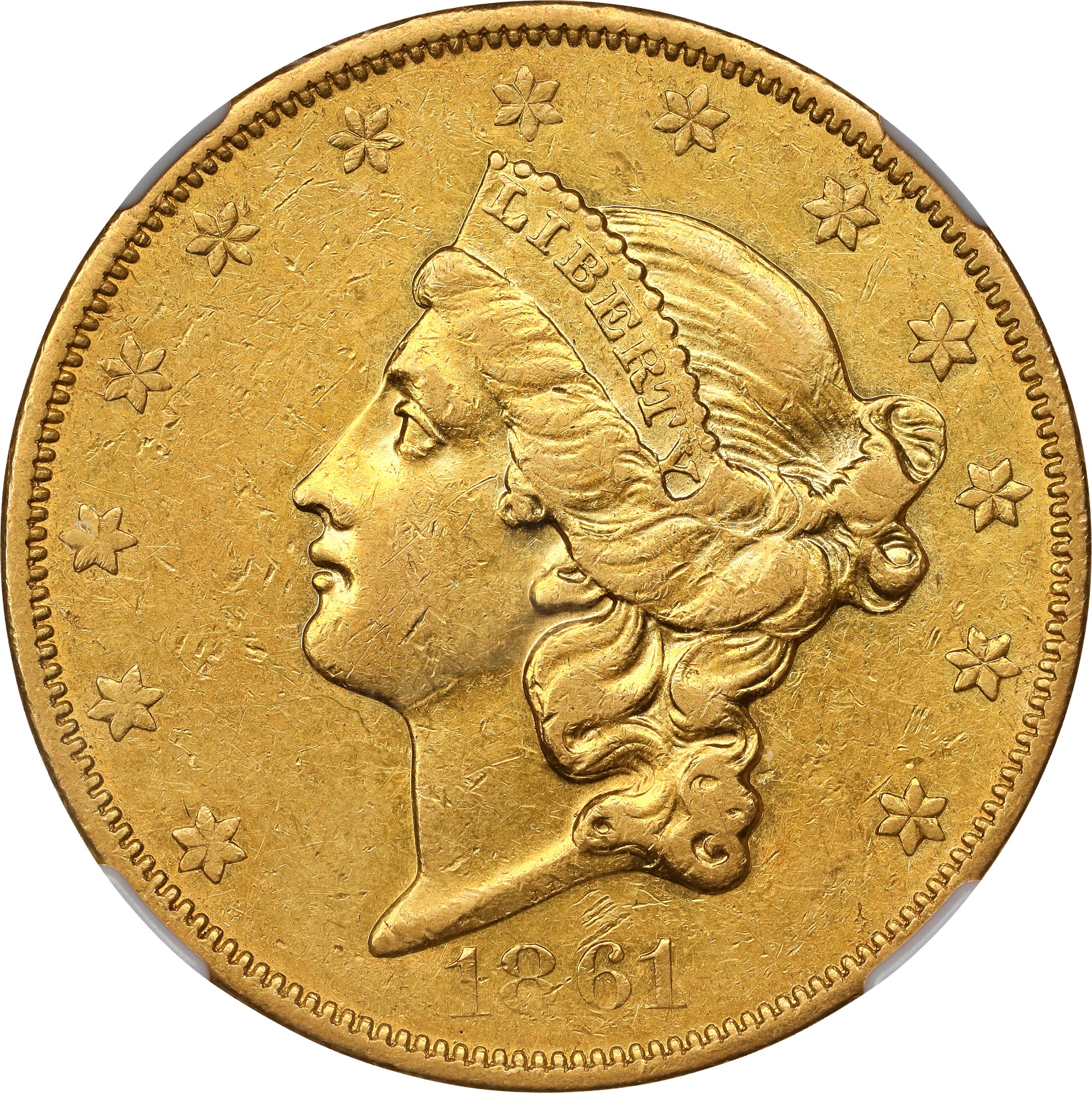
1861-O $20 MS (PCGS#8934)
Summer 2026 Global Showcase Auction U.S. Coins
- Auctioneer
- Stack's Bowers
- Lot Number
- 2495
- Grade
- AU53
- Price
- 39,040
- Lot Description
- This is a desirable NGC-certified example of one of the most eagerly sought Type I Liberty Head double eagles. Bright honey-gold color blankets both sides, accented by subtle olive and rose highlights. Strong light brings out traces of a semi-prooflike finish that is most intense in the protected areas around the devices. Boldly defined in most areas and free of singularly mentionable handling marks, although wispy hairlines and glossiness to the texture are noted for accuracy. Given the historical significance and rarity of this issue, we anticipate that this coin will have no difficulty finding its way into an advanced collection of double eagles or Southern gold coinage.<p>The desirability of the 1861-O double eagle is well established and stems from two important characteristics of this issue. First, the 1861-O is a scarce issue in all grades with no more than 175 coins believed extant from a mintage of 17,741 pieces. Based on this estimate Doug Winter (<em>Gold Coins of the New Orleans Mint: 1839-1909</em>, 2025 edition) ranks the 1861-O seventh in rarity among the 13 New Orleans Mint issues in the Liberty Head double eagle series, ahead of the 1850-O, 1851-O, 1852-O, 1853-O, 1857-O and 1858-O.<p>Second, the mintage for the 1861-O comprises coins that were struck under three different governments - a unique occurrence in the Liberty Head double eagle series and a circumstance that has affected few other issues throughout U.S. coinage history. The mintage for the 1861-O can be divided as follows:<p>-January 1-26, 1861: 5,000 coins struck under the authority of the United States of America<p>-January 26-March 31, 1861: 9,750 coins struck under the authority of the State of Louisiana after it seceded from the Union and took over control of the New Orleans Mint<p>-April 1-30, 1861: 2,991 coins struck under the authority of the Confederate States of America after Louisiana joined the Southern Confederacy<p>Production of the 1861-O, therefore, closely followed the shifting political landscape of the nation during the months leading up to the outbreak of armed hostilities that started the Civil War. The close association of this issue with the Confederate States of America, in particular, confirms its desirability among specialized collectors, for the 1861-O double eagle is one of the few regular issue coins produced by that short lived government.<p>All 1861-O double eagles were struck using a single pair of dies, however, and even the pieces produced by the Southern Confederacy bear the legend UNITED STATES OF AMERICA as part of the reverse design. The staff in the New Orleans Mint simply had no other way of creating or otherwise obtaining new double eagle dies after the facility left Union control, and it was forced to use what tools were on hand to strike coins before the supply of bullion became exhausted.<p>How, then, do numismatists differentiate between those coins struck by the Union, the State of the Louisiana, and the Confederate States of America? The process is imprecise and somewhat conjectural, but Doug Winter has identified a late die state of this variety (Die State III) with a bold date and an obverse die crack (as made) from the rim outside star 2 to Liberty's chin. He believes that those late die state examples were struck by the Confederate State of America, and we see no reason to doubt that attribution.<p>The coin we offer here, however, is an early die state example (Die State I) with the digits in the date weakly impressed and no die crack on the obverse. This coin is almost certainly one of the 5,000 1861-O double eagles struck by the United States of America between January 1 and 26 of that year. Assigning this coin to the United States of America seems particularly appropriate since there is also an intermediate die state (Die State II) known to exist for this issue on which the base of the digit 8 in the date has been strengthened by Mint personnel. Die State II examples probably represent some (but perhaps not all) of the coins struck under the authority of the State of Louisiana.