1882 $20, DCAM PR(PCGS#99098)
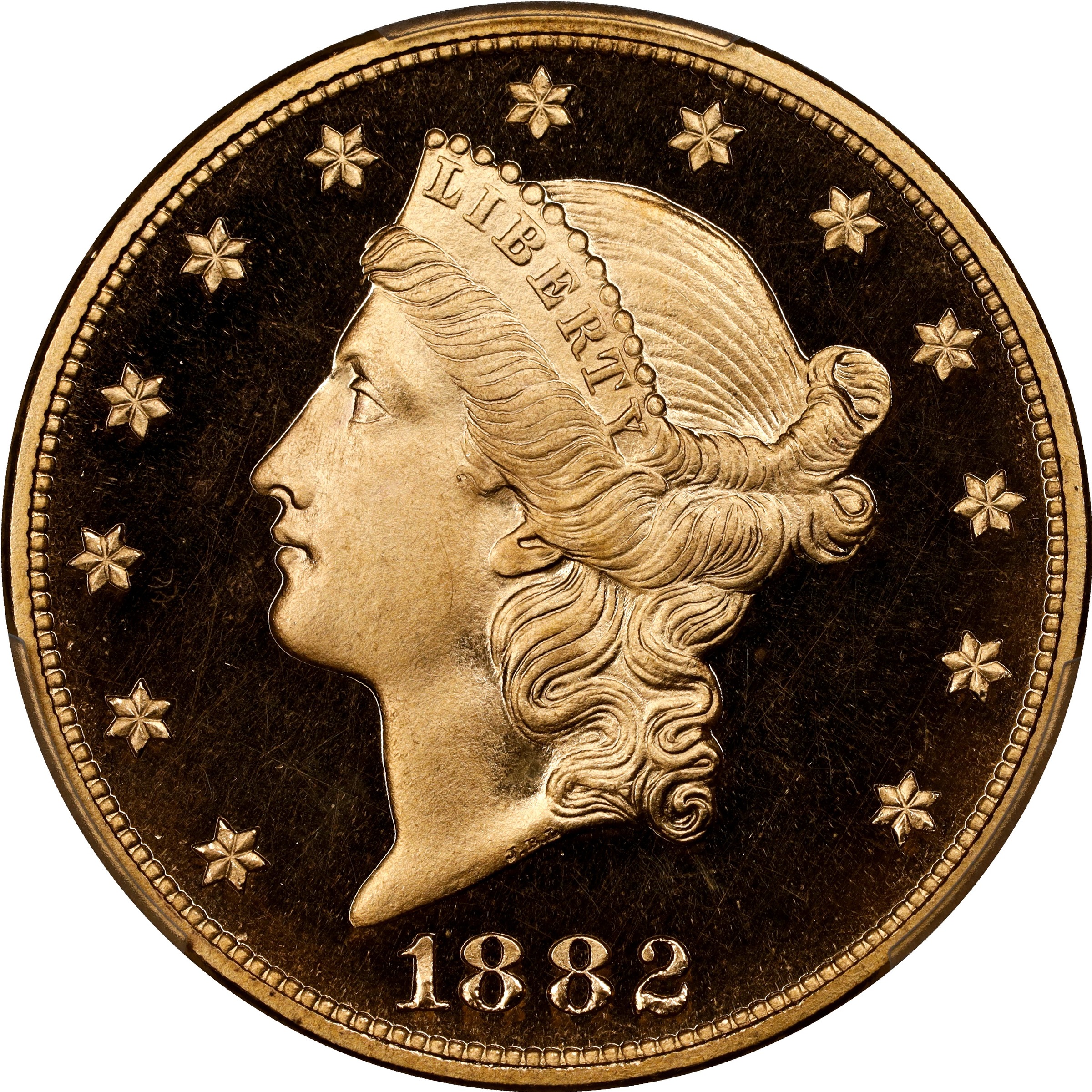
1882 $20, DCAM PR (PCGS#99098)
Spring 2026 Showcase Auction U.S. Coins
- 競売業者
- Stack's Bowers
- ロット番号
- 3106
- グレード
- PR66DCAM
- 価格
- 810,000
- ロット詳細
- An American numismatic treasure. A museum-quality rarity. As one of the finest known Proofs from a famous low mintage date in the Liberty Head double eagle series, the significance of this dazzling premium Gem Ultra Cameo 1882 can hardly be overstated. Its offering in this sale represents what could very well be a once in a lifetime bidding opportunity for advanced numismatists, be they top-quality double eagle date collectors or specialists in classic U.S. Mint Proof gold coinage. Demand from both segments of the collecting community far outstrips supply, for the 1882 is a legendary low mintage rarity in both Proof and circulation strike formats. While all Proof Liberty Head double eagle issues are classic rarities, to understand why the Proof 1882 is desired above many others in its series we must first look at the situation regarding the year's circulation strike coinage at the Philadelphia Mint.<p>The early to mid-1880s represents a historically significant, indeed remarkable era that saw extremely limited circulation strike double eagle production at the nation's main coinage facility in Philadelphia. While the San Francisco Mint kept up a steady coinage of this large gold denomination at the time, the mints at Philadelphia and Carson City prioritized production of the $10 eagle and $5 half eagle. Carson City Mint export Rusty Goe provides the following explanation for this unusual situation in the "Historical Setting" chapter for the 1880-CC half eagle in his outstanding 2020 reference <em>The Confident Carson City Coin Collector</em>:<p><em>Mint Director Horatio Burchard explained in his annual report for 1880 why the Treasury Department had placed such large orders for lower denominations of gold coins. Imports of gold bullion and coins had surged in the past year and a half. The Mint Bureau apportioned this huge influx of gold to various branches and assay offices located across the country. The Bureau chose to limit the coinage of double eagles in order to ensure a substantial supply of eagles and half eagles. "For the first time [since the introduction of double eagles in 1850]," wrote Burchard, "a successful effort has been made to obtain a large portion of the coinage of gold pieces in denominations less than twenty dollars." (</em>Annual Report of the Director of the Mint to the Secretary of the Treasury for the Fiscal Year Ended June 30, 1880<em>, Washington, DC, 1880, pg. 4.)</em><p><em></em>With few exceptions, yearly mintages at the Carson City Mint had been limited across all denominations since the facility opened in 1870, so the reduction in double eagle coinage after 1879 is less obvious to the casual observer (although admittedly there are no 1880-CC or 1881-CC $20 gold issues). Conversely, the effects of the Treasury Department's new policy at the Philadelphia Mint are both striking and readily evident. For after producing a respectable total of 207,600 double eagles for commercial use in 1879, the Philadelphia Mint reported the following mintages for this denomination over the following eight years:<p>-1880: 51,420 circulation strikes<p>-1881: 2,199 circulation strikes<p>-1882: 571 circulation strikes<p>-1883: 0 circulation strikes<p>-1884: 0 circulation strikes<p>-1885: 751 circulation strikes<p>-1886: 1,000 circulation strikes<p>-1887: 0 circulation strikes<p>The Philadelphia Mint did achieve a respectable mintage of circulation strike double eagles in 1888, when 226,161 pieces were delivered, but additional low mintage years followed in 1889, 1890, and especially 1891 and 1892. Only in 1893 would high mintages again become the norm in the circulation strike Philadelphia Mint double eagle series.<p>With a paltry total of 571 coins produced, the circulation strike 1882 double eagle was clearly a major rarity from the start. Attrition through commercial use and, eventually, melting has taken its toll and today only 30 or so examples are believed extant in all grades. With most of the survivors circulated to one degree or another, the circulation strike 1882 is also a major condition rarity that Q. David Bowers describes as "Impossibly rare [in] Mint State" in his 2004 <em>Guide Book of Double Eagle Gold Coins</em> authored for Whitman. Indeed, PCGS and NGC combined report only seven grading events for the 1882 double eagle in all Mint State grades, which includes a single coin in NGC Unc Details.<p>Clearly, most advanced collectors assembling complete sets of circulation strike Liberty Head double eagle will have to settle for a worn example in an AU or lower grade for the 1882. Date collectors, however, can be more flexible since an example of the Proof 1882 - although distinct as an issue from its circulation strike counterpart - will also suffice to represent Philadelphia Mint double eagle coinage of the year. Given that these special coins were made expressly for collectors, it should come as no surprise to read that most surviving Proof 1882 double eagles are well preserved and grade Proof-63 or finer. While this provides more date collectors with the potential to acquire a high-grade coin in an 1882-dated Philadelphia Mint double eagle it is important to recognize that this issue, like all those in the classic U.S. Mint Proof gold series, is a major numismatic rarity.<p>Given the high purchasing power that a $20 gold coin represented in the United States of the 1880s, it is little wonder that few contemporary collectors could afford to acquire and subsequently preserve a Proof. The Mint's production of these coins was limited as a result, and in 1882 it reported a mintage of just 59 Proof double eagles. Typical for the era, these coins were delivered in multiple batches throughout the year to meet anticipated or actual demand. Writing in the 2018 volume in his outstanding <em>United States Proof Coins</em> series, John W. Dannreuther reports the following quarterly deliveries that comprised the 59-coin mintage of the Proof 1882 double eagle: 27; 2; 20; 10. The author further states that 25 of the 27 coins produced during the first quarter of the year were delivered on February 14 for sale as part of the year's Proof sets, as were 15 of the 20 coins produced during the third quarter, those being delivered on August 12. The remaining coins delivered throughout the year were for individual sale and distribution.<p>In the event, however, not all these coins found buyers at the time, and many remained in the Mint until they were eventually destroyed through melting. Today fewer than 20 different examples can be accounted for, with some of the leading numismatic references in the modern market providing the following estimates for the number of Proof 1882 double eagles extant:<p>-<em>A Guide Book of Double Eagle Gold Coins</em> (2004), by Q. David Bowers: 12 to 15 known<p>-<em>A Numismatic History & Analysis: Type III Double Eagles 1877-1907</em> (2004), by Mike Fuljenz: 13 to 16 known<p>-<em>Encyclopedia of U.S. Gold Coins 1795-1933</em> (2008), by Jeff Garrett and Ron Guth: 12 to 15 known<p>-<em>United States Proof Coins</em> (2018), by John W. Dannreuther: 14 to 18 known<p>-<em>PCGS CoinFacts</em>: 14 to 16 known<p>Such estimates confirm the 1882 as one of the rarest post-1858 issues in the Proof Liberty Head double eagle series, with John W. Dannreuther further confirming that, "Only the 1880 bests it for rarity for the Proofs of the 1880s."<p>The number of Proof 1882 double eagles available to today's advanced collectors is further reduced since three of the survivors are permanently impounded in museum collections, two as part of the National Numismatic Collection in the Smithsonian Institution, and the third part of the American Numismatic Society's holdings. With Jeff Garrett and Ron Guth further reporting that "The date is rarely seen for sale," it is obvious that those specimens in private hands usually spend years, if not decades as part of tightly held collections.<p>With so few coins extant, and market appearances few and far between, the opportunity to acquire any Proof 1882 double eagle through auction is a rare and fleeting one that requires the most aggressive bidding strategy. The opportunity to acquire a Gem must be considered rarer still for, while most Proof 1882 double eagles have been well preserved, the vast majority still show evidence - however trivial - of numismatic handling on the part of earlier generations of collectors. In particular, the delicate fields of these large-size coins acted as magnets for hairlines and other light blemishes, even just a few stray marks being sufficient to confine the coin to a certified grade below the Proof-65 level by today's strict standards.<p>It is with eager anticipation of robust bidding activity among astute gold collectors, therefore, that Stack's Bowers Galleries is pleased to present one of the finest certified Proof 1882 double eagles in this beautiful PCGS/CAC Proof-66 Deep Cameo specimen. Its expertly preserved, virtually pristine surfaces allow ready appreciation of the outstanding qualities that define this issue. Proofs of this era were individually struck, by hand, on the Mint's screw press from specially polished dies, using a polished planchet. Such meticulous production methods imparted the full strike detail and awesome field-to-device contrast seen on both sides of this coin. In addition to deep mirrored reflectivity, the fields also show the desirable orange peel texture seen on many of the U.S. Mint's late 19th century Proof gold coins. Once thought to be unique to these coins, this texture has since been noted for other series, and is the result of Mint employees overheating the planchets while preparing them for coinage. Bathed in lovely orange-gold color, both sides are expertly preserved and approach numismatic perfection. With no post-production blemishes to report, we are left with a trivial planchet flake in the obverse field inside star 12 and a few faint planchet streaks in the right reverse field - all as-made features - to serve as identifiers for preserving this coin's provenance through future market appearances. The eye appeal is exceptional, a fitting match to the outstanding technical quality.<p>When offered in Heritage's October 2012 ANA Signature Auction, as NGC/CAC Proof-66 * Ultra Cameo, this coin was the finest Proof 1882 double eagle certified by PCGS or NGC; it was rightly described by the Heritage cataloger at that time as, "By Far the Finest Graded." Since then, PCGS has reported a single grading event for this issue in Proof-66+ Deep Cameo, but the present specimen remains the only Proof-66/66+ Deep Cameo verified by CAC (the CAC Stickered Population of 2/0 as of mid-January 2026 represents submissions of this coin in both its previous NGC Proof-66 * Ultra Cameo and current PCGS Proof-66 Deep Cameo holders). As one of the two finest certified Proof 1882 double eagles, and the only one at this grade level approved by CAC, the present example represents incredible and unsurpassable quality for an issue that is a prized rarity in all grades. It is one of the most desirable Proof Liberty Head double eagles of any date available for private ownership and is a coin that will serve as a centerpiece in the even the finest numismatic cabinet.<p>