1862 $3, DCAM PR(PCGS#98025)
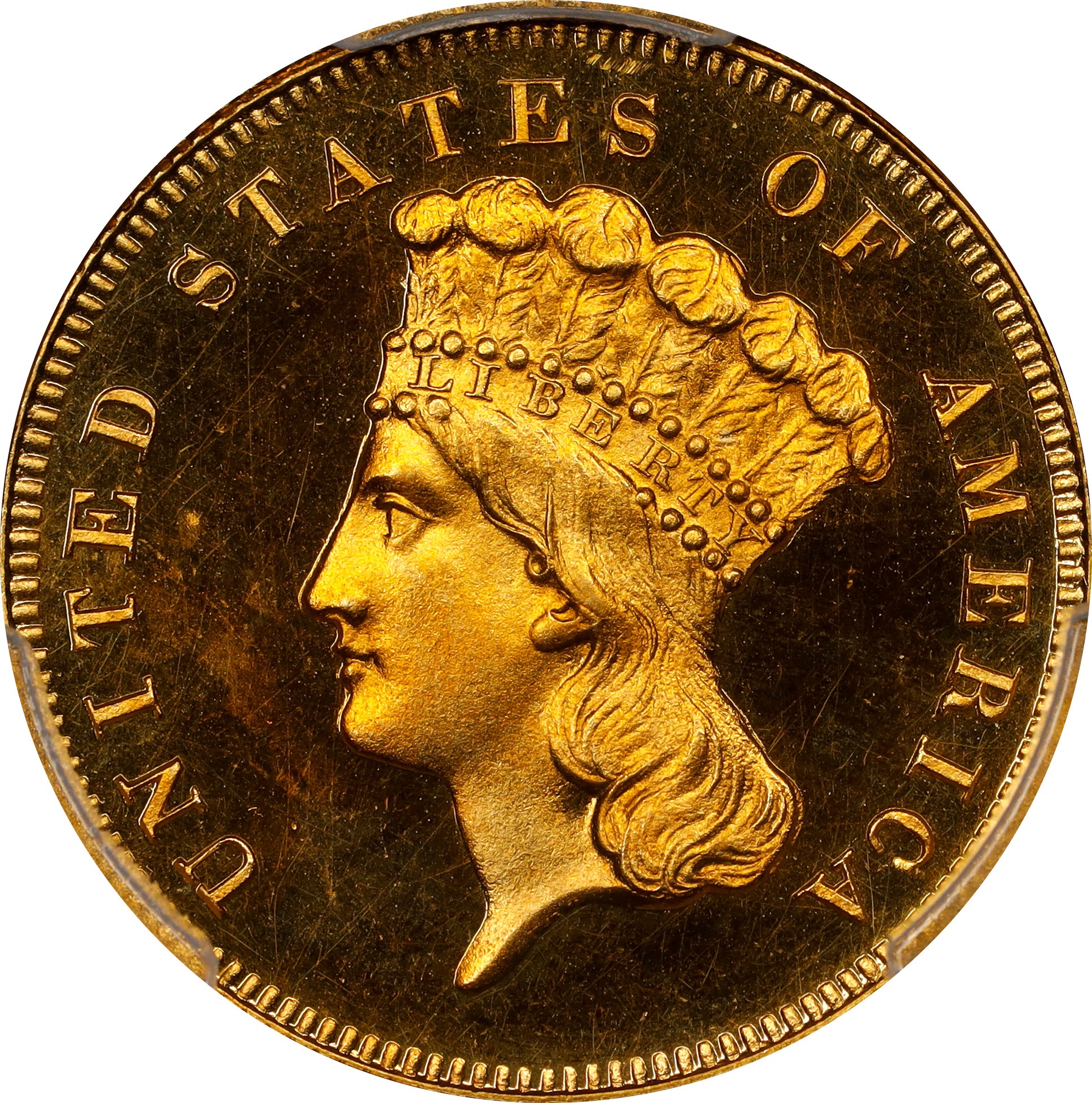
1862 $3, DCAM PR (PCGS#98025)
Spring 2026 Showcase Auction U.S. Coins
- Auctioneer
- Stack's Bowers
- Lot Number
- 3125
- Grade
- PR66DCAM
- Price
- 156,000
- Lot Description
- The year 1862 saw profound changes at the Philadelphia Mint. After a string of early Confederate victories in the Civil War, including the First Battle of Bull Run, uncertainty over the outcome of the conflict led to Northern banks suspending gold specie payments late in 1861. Subsidiary silver coinage had remained generally at par with the paper Demand Notes of 1861, which explains the sizable mintages of half dimes, dimes, quarters, and half dollars at Philadelphia in 1861 and early 1862. The Legal Tender or "greenback" notes issued in the spring of 1862, however, were not redeemable in either gold or silver, and their appearance in quantity was quickly followed by the withdrawal of silver coinage from circulation in the East and Midwest after June of that year.<p>The hoarding of gold and silver was followed by a sharp reduction in circulation strike coinage for most denominations that would continue well into the Reconstruction era. The three-dollar gold piece was not much affected by this, however, since mintages for commerce had already plummeted by the late 1850s when the unpopularity of the denomination became obvious. (It was actually largely superfluous as circulating specie from the start of the series in 1854.) The 5,750 circulation strikes struck at the Philadelphia Mint in 1862, therefore, continued the trend of extremely limited mintages that, with a single exception in 1859, began in 1858.<p>On the other hand, one major change early in the Civil War did affect the three-dollar gold series, specifically the Proofs, and it was a new policy on the part of the Mint. In 1860 and 1861, the Mint followed the policy of Director James Ross Snowden and offered Proofs both individually and as part of sets. In late 1861, however, his successor James Pollock changed this policy and beginning in 1862, collectors could no longer obtain individual Proof coins unless a new denomination or design was introduced mid-year. This policy remained in force for Proof gold coins until 1881, when individual specimens became available once again.<p>The requirement to buy a complete Proof set to obtain these coins certainly put a damper on collector demand, especially for the expensive gold and complete Proof sets, and especially under the uncertain economic conditions that prevailed during the war. The Mint adjusted its expectations and produced only 35 gold Proof sets in 1862, all delivered on February 16. For the three-dollar gold piece this was a huge decrease in production from the overconfident days of 1859, 1860, and 1861, in which years the Mint struck 80, 119 and 113 $3 Proofs, respectively. Of the Proof 1862 threes, fewer than half survive today, 14 to 16 per John W. Dannreuther (2018), and that offered here is one of the very finest and, in fact, the single finest certified in the Deep Cameo category to have met with CAC approval.<p>The surfaces are virtually flawless, just a few trivial lint marks and planchet voids scattered about, and no post-production blemishes of note. Both sides are fully struck with strong field to device contrast that readily supports the desirable DCAM designation from PCGS. Color is likewise superb in a deep, rich, vivid orange-gold. Breathtakingly beautiful and of the utmost significance, the desirability of this special coin knows no bounds.