1798 $5 Large 8, 13 Star Reverse MS(PCGS#8078)
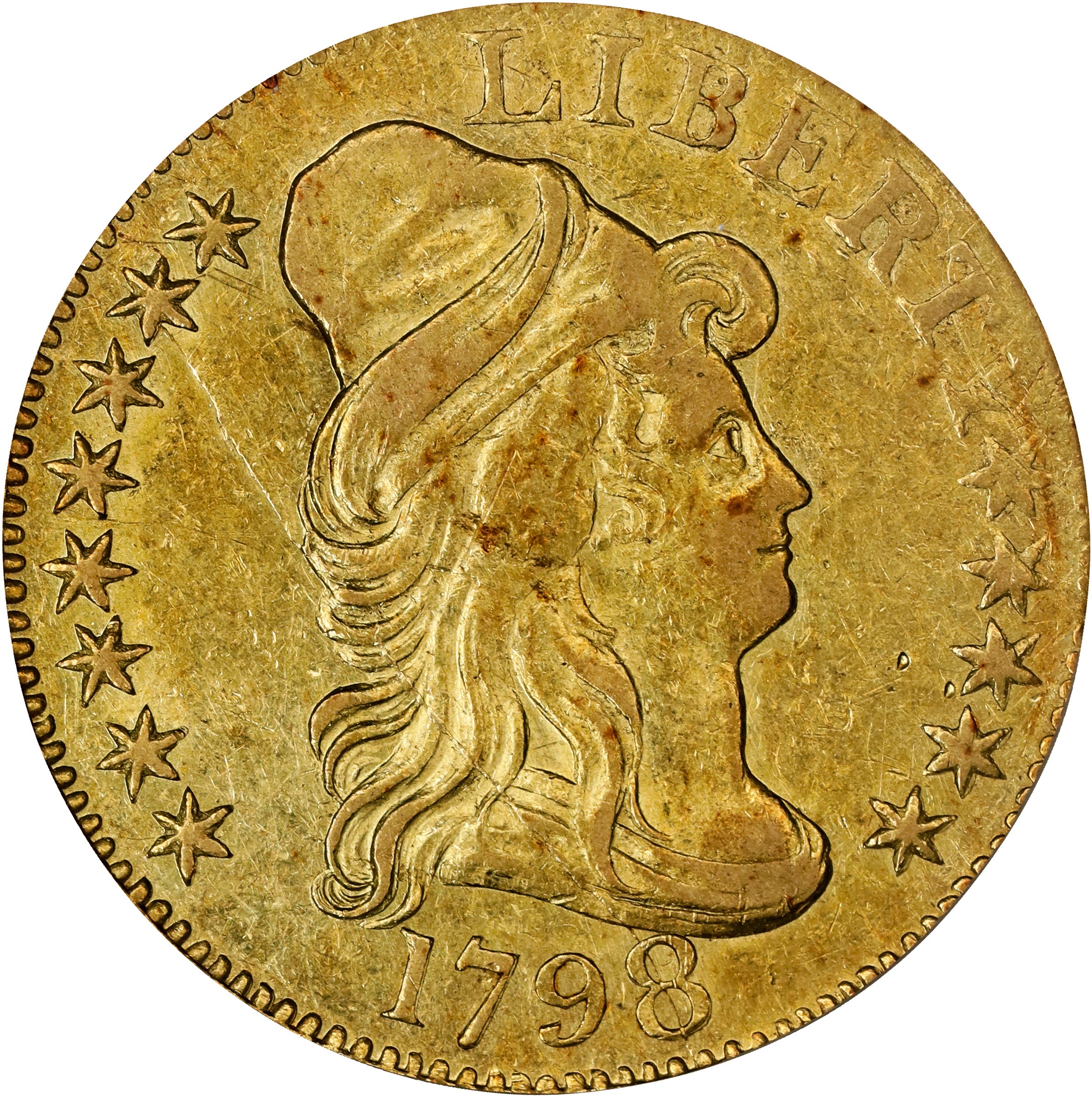
1798 $5 Large 8, 13 Star Reverse MS (PCGS#8078)
Summer 2026 Global Showcase Auction U.S. Coins
- Auctioneer
- Stack's Bowers
- Lot Number
- 5210
- Grade
- VF30
- Price
- 8,540
- Lot Description
- BD Die State c/b. Moderately, yet evenly circulated, both sides retain flickers of frosty mint luster as well as generally bold detail. Appealing olive-gold coloration overall with a blush of coppery iridescence near the upper reverse border. Marks pepper both sides, as expected for a pre-1834 U.S. Mint gold coin in this grade, although none are individually distracting during in-hand viewing.<p>One of the principle denominations in the early days of the Republic, the half eagle required the Mint to produce as many of the coins as possible despite many roadblocks. In the first few years of the Mint's operations, regular outbreaks of yellow fever frequently interrupted die preparation and coinage for months at a time. To alleviate this, some creative die pairings for gold coins were often employed, leading to such oddities as the famed 1798 Small Eagle reverse. In addition, to reduce the amount of work to produce dies, various hubs on hand were also mixed and matched in unusual combinations. One such combination is the Bass-Dannreuther 5 variety of the 1798-dated half eagle issue, which is characterized by a large 8 in the date and notably a reverse die with 13 stars. The reverse die bears several distinct design elements that are now believed to be the work of John Gardner, in particular the long thin eagle neck, two rows of tail feathers, and the arrangement of the 13 stars in a symmetrical "star cross" pattern. Gardner had left the Philadelphia Mint two years prior and it is strongly suspected that his hubs were modified by Robert Scot and kept in service for several years after Gardner's departure. While not conclusive, modern scholars continue to investigate these interesting hybrid dies.<p>Roughly one-tenth of the overall reported mintage of 24,867 pieces for this issue is believed to have been struck using this die pair. At some point early on in its service life, the obverse die failed, most evident as a crack developing from star 7 to the back of Liberty's head that quickly advanced to a terminal state. Because of this die pair's short history, examples of the BD-5 attribution are rare with an estimated 30 to 40 surviving.