(1652) Shilling New England MS(PCGS#13)
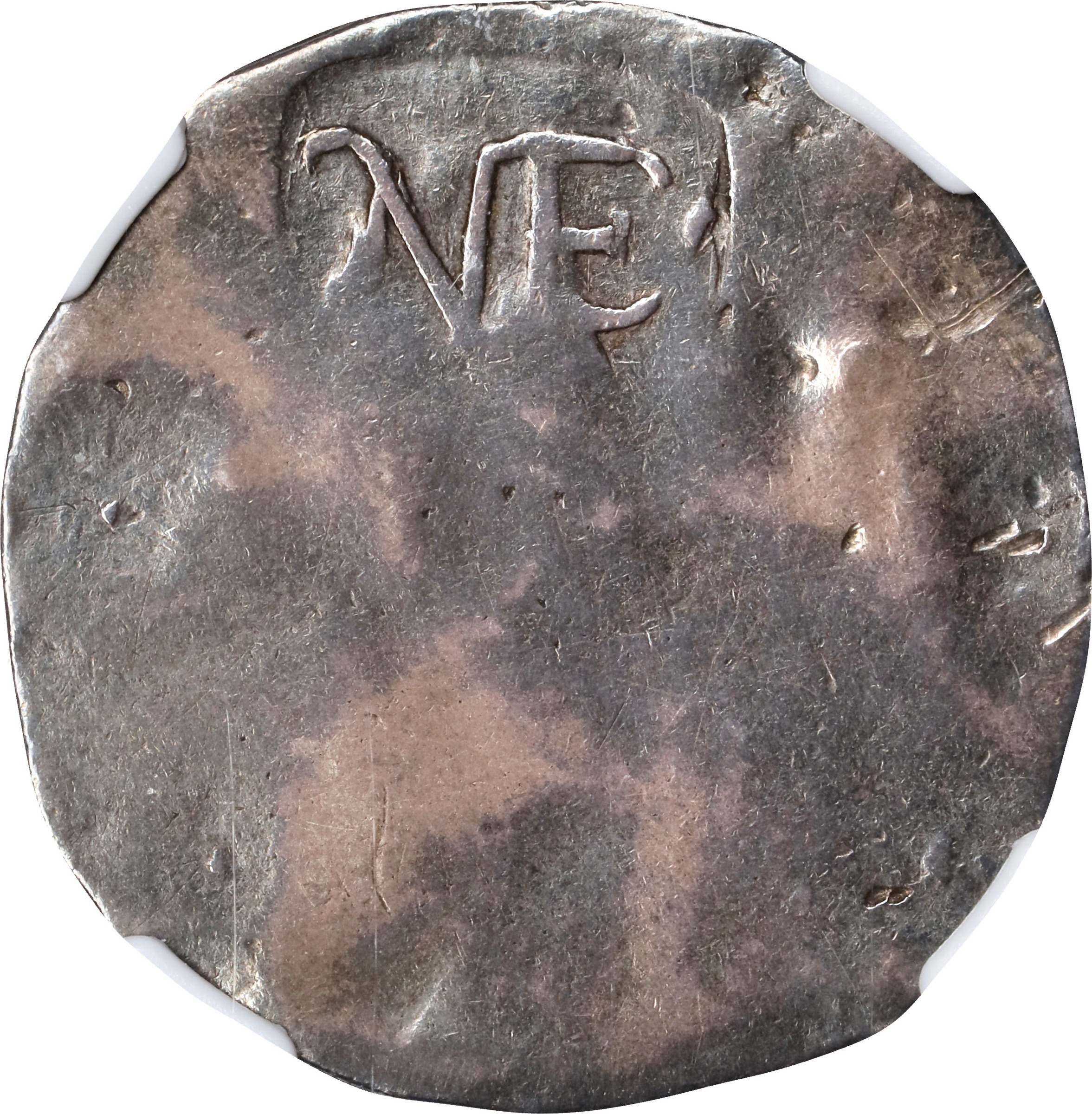
(1652) Shilling New England MS (PCGS#13)
Summer 2026 Global Showcase Auction U.S. Coins
- Auctioneer
- Stack's Bowers
- Lot Number
- 1294
- Grade
- VF35
- Price
- 134,200
- Lot Description
- 69.4 grains. Punch alignment 180 degrees. As the first metallic currency struck in the Thirteen American Colonies , the NE coinage is easily one of the most famous - and important - of all colonial issues. Stack's Bowers Galleries is proud to present one of the best-known examples of the Noe 3-B attribution. Its offering in this sale is a significant event for specialists in the silver coinage of Massachusetts Bay Colony and advanced collectors of U.S. colonial type coins. Aggressive bidding strategies are recommended for, once sold, it is likely that this numismatic treasure will be off the market for an extended period of time, surely as part of a world class cabinet built wholly or in part around American colonial coinage.<p>The act passed on May 27, 1652, by the Massachusetts Bay Colony resulted in the first coins struck in British North America - in other words, the territory that would eventually become the United States. The establishment of a mint in the colony was in reaction to a shortage of circulating coinage as well as the problem of debased silver coins in commerce. John Hull was appointed mintmaster with Robert Sanderson, Sr. as his partner. They were the premier silversmiths in the British colonies at the time but lacked knowledge or experience as coiners. As such, the first coins that they produced for Massachusetts were made using the familiar techniques of silversmiths.<p>Since a proper press for striking coins was also still in the future for the colony, the first coins produced by Hull and Sanderson were made using simple device punches similar to those of a silversmith's hallmark. These punches sufficed since the General Court of the Massachusetts Bay Colony mandated that the first coins carry only an NE design on one side, for New England, and an expression of the denomination in Roman numerals on the other. This is the historic, famous and rare NE coinage produced in denominations of shilling, sixpence and threepence. The first examples were produced sometime after the authorizing act became valid on September 1, 1652, although the exact date is unknown. It is also not known how long NE coinage remained in production, but new legislation that required a more complex design for the colony's coinage was issued less than two months later, on October 19. According to traditional numismatic wisdom, the improvement in design was intended to combat the problem of clipping and shaving of the NE coins, practices made too easy by the simple design. Louis E. Jordan, in the reference <em>John Hull, the Mint and the Economics of Massachusetts Coinage</em> (2002), states that Hull and Sanderson acquired the colony's first proper press - a rocker press - in 1654. Some have concluded that NE coinage would have had to continue until then because the succeeding coins of the more complex Willow Tree design would have required the rocker press for proper production. Writing in the outstanding 2010 reference <em>The Silver Coins of Massachusetts</em>, however, Christopher J. Salmon argues conclusively that the Willow Tree coinage was produced using the same techniques as its NE predecessors. We can conclude, therefore, that coinage of NE shillings, sixpence and threepence was confined to a few weeks from early September through late October 1652. Mintages were certainly limited, due to both time and the challenges of any mint's first coinage operations, especially one whose mintmaster and assistant were not skilled in their new craft and further burdened by the realities of living and working in 17th century New England.<p>The minting process for the NE shillings began when silver plate or Spanish colonial silver coins were brought to Hull and Sanderson's shop for melting and assay adjusting to bring the fineness up the sterling quality. Exactly how the planchets were produced is unknown, but it was probably through hammering or pouring the molten silver into ingot molds and, once cooled, drawing on a bench through cast iron rollers. Christopher J. Salmon continues the process in his work on Massachusetts Bay Colony silver:<p><em>The NE stamp was applied with a punch similar in appearance and style to a silversmith's touchmark or hallmark punch. This was done on the 12 o'clock position of the silver blank. The flan was then turned over and struck with the denomination punch at the reverse side of the 6 o'clock position, so selected for symmetry, and more importantly, to avoid marring or entirely obliterating the impression of the NE punch. The punches would probably have been hit sharply with a large hand-held hammer with the cold flan placed on the surface of a large steel anvil embedded in a tree trunk, according to standard silversmith methods of the time.</em><p><em></em>The punches that Hull and Sanderson used for the NE shillings wore down quickly, not surprising given their coining methods, and required regular recutting of the design elements to keep them usable. Writing in <em>The Colonial Newsletter</em> in 2010, Jack Howes demonstrated that all three NE shilling obverse punches are actually the same punch that had been significantly recut twice. Despite continual recutting, strikes from the punches were almost always incomplete, although this is also in keeping with silversmith practices of the time, hallmarks on contemporary silverware usually asymmetrical with one side of the mark slightly less defined than the other. Salmon ascribes this to "angulation of the punch during hammering."<p>Numismatic scholars have identified six different varieties of NE shilling, using three different states of the same NE punch and four distinct XII denomination punches. The offered coin is attributed as Noe 3-B, the obverse punch crudely recut from the slender (although impractical) lines of the Noe 2 state, resulting in angular rather than smoothly curved upper right and left serifs on the letter N. A distinct serif has also been added to the top horizontal of the E. Noe Reverse B is most readily identifiable by a prominent linear punch break from the lower right border that extends up across the lower left side of the second Roman numeral I. In later states this break expands to involve the bottom of the first Roman numeral I and the lower right side of the X.<p>Given the limited number of coins presumably struck and a high rate of attrition through commercial use and eventually melting, it is little wonder than the NE shilling as a type is an extreme numismatic rarity in the market of the 21st century. Including recent discoveries, no more than 70 examples of all varieties combined are believed extant, fully 22 of which are permanently impounded in institutional collections such as the American Numismatic Society, the British Museum, and the Smithsonian. Noe 3-B is a rare variety among a rare design type, and it was missing from some of the most important collections of Massachusetts silver ever formed, including Stearns, Garrett, Picker, Norweb, Roper, the Hain Family Collection, Massachusetts Historical Society (1970), and Oechsner. Only 11 examples of this Noe number are positively confirmed to exist, as follows, with the grades of the uncertified pieces estimates:<p>1 - <strong>NGC MS-61</strong>. Ex Hon. Wentworth Beaumont; Morton & Eden, Ltd.'s sale of the Beaumont Family Collection, Catalogue No. 113, November 2021, lot 1034; our Winter 2022 Auction, November, lot 3103. Discovered in the United Kingdom just prior to the Morton & Eden sale, this coin was found in a tin containing numerous other coins and medals. It was probably acquired by William Wentworth (1616-1697), an early settler in the American colonies who is thought to have landed in New England in 1636. Howes unlisted; Borckardt, Augsburger et al. 1.<p>2 - <strong>NGC AU-58</strong>. Ex Abner Kreisberg's "Collector's Portfolio" Public Coin Auction, October 1978, lot 2; our November 2024 Showcase Auction, lot 1102. Howes 4; Borckardt, Augsburger et al. 5. Previously certified AU-53 by PCGS.<p>3 - <strong>PCGS AU-55</strong>. Ex New York Stamp & Coin Company's sale of the Robert Coulton Davis Collection, January 1890, lot 2352; Thomas Hall; Virgil Brand; Carl Wurtzbach (Plate Coin 4); T. James Clarke; F.C.C. Boyd; John J. Ford, Jr.; our (Stack's) sale of the John J. Ford, Jr. Collection, Part XII, October 2005, lot 2; Jon Hanson, October 18, 2005; Donald Groves Partrick; Heritage's sale of the Donald Groves Partrick Collection, January 2015 FUN Signature Auction, lot 5517, as NGC/CAC AU-58. Howes 2, Borckardt, Augsburger et al. 2.<p>4 - <strong>PCGS AU-55</strong>. Ex Sotheby's (London) Property of the Trustees of the Late Walter, Lord Cunliffe of Headley, the Property of E.J. Willes, Esq., etc., sale, May 1966, lot 154, via Spink's.; our sale of the Henry P. Kendall Foundation Collection, March 2015 Baltimore Auction, lot 2305. Howes 7; Borckardt, Augsburger et al. 3.<p>5 - <strong>PCGS AU-53</strong>. Ex B. Max Mehl's sale of the William Cutler Atwater Collection, June 1946, lot 1; B. Max Mehl's sale of the Oliver E. Futter Collection, November 1954, lot 1965-A; R.R. Wilson, 1980; Alan V. Weinberg; Heritage's sale of the Alan V. Weinberg Collection, Part III, January 2020 FUN Signature Auction, lot 4054. Howes 5; Borckardt, Augsburger et al. 4.<p>6 - <strong>PCGS AU-53</strong>. Ex George H. Clapp; Mayflower Coin Auctions' sale of October 1957, lot 5; our (Stack's) sale of the James E. Stiles Collection, June 1981, lot 2; Rex Starck, January 2014. Howes 6, Borckardt, Augsburger et al. 6.<p>7 - <strong>PCGS/CAC EF-40</strong>. Discovered in Great Britain; ex our Americana Sale of January 2013, lot 10615; Heritage's sale of the Poulos Family Collection, August 2019 Chicago ANA Signature Auction, lot 3630; Heritage's sale of the James E. Blake Collection of United States Colonial Coins & Tokens, August 2023 ANA Signature Auction, lot 3002. Howes 9; Borckardt, Augsburger et al. 7.<p>8 - <strong>Extremely Fine</strong>. Ex Thomas L. Elder's sale of the Peter Gschwend Collection, June 1908, lot 1. Howes 8; Borckardt, Augsburger et al. 8.<p>9 - <strong>Extremely Fine</strong>. Ex William B. Osgood Field; American Numismatic Society (Inv. 1946.89.72). Howes 1; Borckardt, Augsburger et al. 9.<p>10 - <strong>NGC VF-35</strong>. Ex our (Stack's) sale of the Ellis Robison Collection, February 1982, lot 4; our (Stack's) March Sale, Part II, 1984, lot 915; Heritage's sale of the Christopher J. Salmon Collection, August 2022 Signature Auction, lot 3241. Howes 3; Borckardt, Augsburger et al 10. <em><strong>The present example</strong></em>.<p>11 - <strong>Very Fine</strong>. Ex Chauncey C. Nash; Harvard University. Howes unlisted; Borckardt, Augsburger et al. 11.<p>When offered in our (Stack's) February 1982 sale of the celebrated Robison Collection, this coin was cataloged as:<p><em><strong>1652 New England Shilling.</strong> Noe III-B. 69.4 grains. An excellent impression of both the obverse and reverse monograms, although the lower stroke of the N is worn into the field. The reverse die break in the lower right of the XII is evident. The planchet exhibits a few teeth marks [sic] on both sides, as do many NE Shillings, but is full and round with no evidence of clipping. Pleasing natural gray color, and excellent overall appearance. One of the rarest and most significant pieces in the collection. <strong>Very Fine or better.</strong></em><p>Although brief, this description provides a fairly accurate description of the coin's appearance. We expand upon it only by noting that the planchet exhibits gentle waviness throughout, the toning deep steely-charcoal in the recesses and lighter pewter gray on the high points. The break on the reverse described as "in the lower right of the XII" confirms the late state of this attribution where this break involves the bottoms of all three digits in the Roman numeral.<p>As a technically sound and aesthetically pleasing example of colonial North America's first coin - the famous and rare NE shilling - this is a numismatic treasure with few equals in today's market. It will surely have no difficulty finding its way into an advanced colonial type set or specialized collection of Massachusetts Bay Colony silver.