1907 $20 J-1778/1907 Sans Serif Edge Ultra High Relief PR(PCGS#81954)
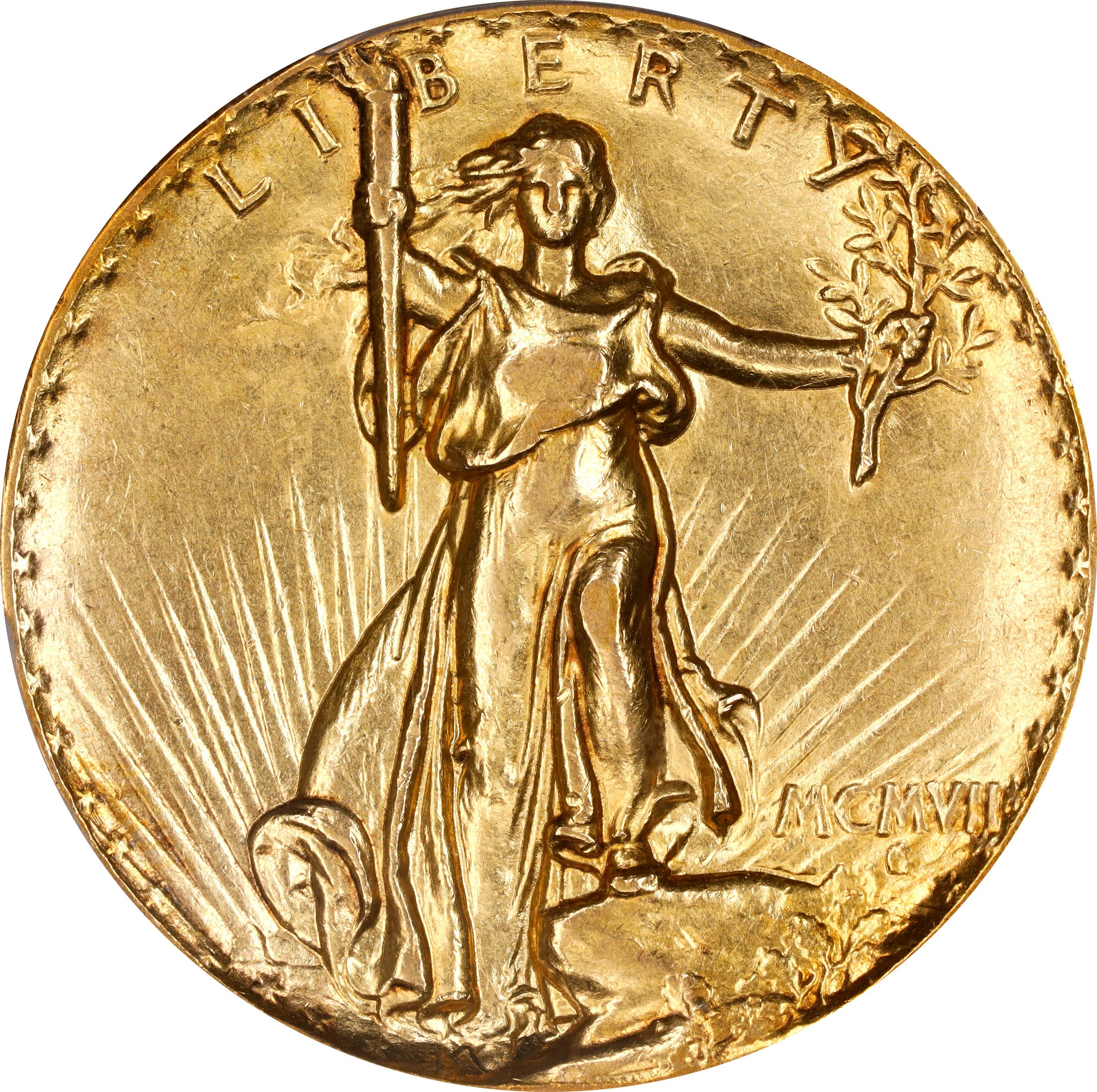
1907 $20 J-1778/1907 Sans Serif Edge Ultra High Relief PR (PCGS#81954)
February 2026 Showcase Auction - The James A. Stack, Sr. Collection Part II
- Auctioneer
- Stack's Bowers
- Lot Number
- 25165
- Grade
- PR58
- Price
- 840,000
- Lot Description
- Stack's Bowers Galleries is pleased to once again offer this celebrated rarity among Ultra High Relief double eagles - one of only two examples with the Sans Serif or Gothic Lettered Edge of 1906 that survives from a mintage of three pieces. Discovered in the early 1990s, this extraordinary Ultra High Relief double eagle was struck inside the three-segment collar created by Charles E. Barber for his unique 1906 pattern Helmeted Head double eagle (Judd-1773/Pollock-1992). This collar bore the nation's Latin motto in small sans-serif letters separated by 13 stars: E*P*L*U*R*I*B*U*S*U*N*U*M*. The normal edge device used on all succeeding Ultra High Relief double eagles was the Roman-style, serif-lettered motto: *E*PLURIBUS*UNUM**********. Comparison with Ultra High Relief specimens in the National Numismatic Collection in the Smithsonian Institution, expedited by the late Elvira Clain-Stefanelli, revealed that 1906-style lettering was also used on the experimental extra-thick piéfort double eagles with the diameter of a $10 gold eagle (Judd-1779), also housed in the National Numismatic Collection.<p>Any Ultra High Relief double eagle is a numismatist's dream, but this breathtaking coin is in a class by itself. The Saint-Gaudens' coinage was the result of an unprecedented partnership of the youthful and energetic President Theodore Roosevelt and America's greatest sculptor, Dublin-born Augustus Saint-Gaudens. Roosevelt admired the artist profoundly and invited him to the White House to plan what the President later called ''My pet crime,'' the drastic overhaul of the nation's coin designs. A glance at the artist's earlier interaction with the Philadelphia Mint shows that Saint-Gaudens must have felt profound reservations at tangling once again with the Mint and its irascible chief engraver, Charles E. Barber. The sculptor and engraver had crossed swords twice before, to Saint-Gaudens' great loss and lingering displeasure.<p>During 1891, he and nine other artists were invited by Congress to participate in a contest to redesign the nation's silver coinage, whose Liberty Seated design went back to 1837. The artists rejected the call, citing inadequate time and compensation for what would have been a significant investment of their productive time. A second attempt at competition saw Saint-Gaudens, Barber, and Boston engraver Henry N. Mitchell appointed judges for an open contest that never got off the ground.<p>Barber took advantage of these false starts to buttress his fanatically held position that only U.S. Mint engravers had the knowledge and skill to even attempt coin design. With the artists out of the running, he swiftly filled the vacuum with his own banal dime, quarter and half dollar designs, forever known as the Barber types, struck from 1892 to 1916.<p>The two next joined in combat over the U.S. Mint's award medal for the 1892-1893 World's Columbian Exposition. Saint-Gaudens created a bold obverse showing Columbus stepping ashore on San Salvador, arms outstretched in ecstasy at finding land after his seemingly endless transatlantic voyage. The reverse was more artistic than pictorial, showing a nude youth holding a torch and victor's crowns. The artist's son Homer recalled that this design was derailed by an artful early ''leak'' of confidential government information. The Page Belting Company was able to get hold of the design and distributed copies of a grossly bowdlerized pornographic parody. Mint Director John Griffin Carlisle cancelled Saint-Gaudens' reverse design and Barber gleefully substituted his own, showing Columbus' ship squashed under an enormous tablet inscribed with the exposition name and dates. The furious Saint-Gaudens denounced this ''act of rare shamelessness,'' but no one in authority cared to listen.<p>It took all of Roosevelt's boundless energy and persuasiveness to overcome Saint-Gaudens' deep seated reluctance to ever involve himself again with the Mint. On November 6, 1905, Roosevelt wrote to the sculptor after a dinner discussion in which both agreed that U.S. coinage was sorrowfully deficient in artistic quality. Roosevelt reported that, ''I was looking at some gold coins of Alexander the Great today, and I was struck by their high relief. Would not it be well to have our coins in high relief, and also to have the rims raised?'' Their target would be the gold coinage that had seen only minor change since Christian Gobrecht's designs were adopted in 1838.<p>The artist warned the President up front that while his desired high relief would be certainly aesthetically worthy, ''The authorities on modern monetary requirements would, I fear, 'throw fits' to speak emphatically, if the thing were done now...'' Somewhat later, Saint-Gaudens spoke humorously of Barber's long term in the engravership, suggesting that he had been there before the establishment of the Republic and would survive long after, sitting in its ruins. Borrowing a quote from Chicago's comic figure "Mister Dooley," the artist predicted that Barber would be stricken with ''nervous prostitution'' (sic) if the President persisted in his high relief quest. However, persist he did and a greatly encouraged artist went to work despite suffering from a terminal illness. His stated goal was to make his new double eagle with its striding full-form Liberty and majestic flying eagle ''a living thing and typical of progress.''<p>President and artist were braced for Barber's opposition, and the chief engraver obliged, employing procrastination, prevarication, and outright sabotage in his determination to frustrate the projects of the dying Saint-Gaudens. The artist wrote on May 29, 1906, ''If you succeed in getting the best of the polite Mr. Barber down there, or the others in charge, you will have done a greater work than putting through the Panama Canal. Nevertheless, I shall stick at it, even unto death.'' Fortunately the sculptor's assistant Henry Hering was on hand to contend with Barber on a day-to-day basis. Hering agreed that the proposed Ultra High Relief could not realistically be struck for circulation but demanded that the experiment be made to fulfill Saint-Gaudens' wishes. Hering recalled the actual striking in the <em>Hartford Courant</em> in June 1933:<p><em>So a circular gold disk was placed on the die and by hydraulic pressure of (I think it was) 172 tons we had our first stamping and the impression showed about one half the modeling. I had them make a cast of this for my guidance. The coin was again placed on the die and again showed a little more of the modeling and so this went on and on until the ninth stamping when the design showed up in every detail.</em><p>A ''progression set'' struck in lead in the collection of the New York-based American Numismatic Society shows the several stages of obtaining the full Ultra High Relief.<p>Hering's relentless prodding assured that the dies were actually finished and approximately two dozen Ultra High Relief coins were struck, two of which soon returned to the smelter. Hering repeated to the American Numismatic Association's journal, <em>The Numismatist</em>, in August 1949 that he knew the Ultra High Relief was impractical for general circulation, but that he was determined to see the project completed. In the event, one Ultra High Relief coin was sent on loan to Saint-Gaudens and the sculptor was able to savor his completed work before cancer claimed his life in August 1907. It is remarkable that Saint-Gaudens never owned one of his most famous coins, having sent back the loaned example to the Mint on March 13. After his death, his redoubtable widow Augusta lost no time in demanding one of the coins. Roosevelt instructed the Mint to either strike another specimen during 1908 or else send her one of the two examples from the Mint Collection. A coin from that collection was sent to her, for which she directed her lawyer Charles Brewster to send payment of $20.12 to the Philadelphia Mint.<p>Roosevelt had seen the plaster models at the end of 1906, and wrote to the artist on December 20:<p><em>My Dear Saint-Gaudens: Those models are simply immense - if such a slang way of talking is permissible in reference to giving a modern coinage one coin at least that shall be as good as that of the ancient Greeks. I have instructed the Director of the Mint that these dies are to be reproduced just as quickly as possible and just as they are. It is simply splendid. I suppose I shall be impeached for it in Congress; but I shall regard that as a very cheap payment!</em><p>The dies were completed and the first four Ultra High Relief coins were struck between February 7 and 14, 1907, but no new segmented collar had been prepared in time for this initial production run. However, Barber had prepared his own pattern double eagle in 1906 (Judd-1773, Pollock-1992), presenting a large Liberty bust wearing a Phrygian cap on the obverse, nicknamed the Helmeted Head. His reverse offered a standing Liberty holding a liberty cap on pole and a sword with a large eagle behind, originally prepared for an 1891 pattern half dollar (Judd-1766, Pollock-1980). As noted above, he had prepared his own collar to impress the raised letter motto with a star between each letter, E*P*L*U*R*I*B*U*S*U*N*U*M*. This collar was pressed into service for the February 7 to 14 striking period, and was used to produce three of the four coins struck during that time; the fourth was left with a plain edge. The Mint then prepared another collar with the Roman-style, serif-lettered motto *E*PLURIBUS*UNUM**********, which was used to strike two additional groups of Ultra High Relief double eagles, the first between March and July 1907, the second on December 31, 1907.<p>As above, the coin offered here was the first of the Sans Serif (also called Gothic) Lettered Edge coins confirmed in the modern numismatic market. The second Ultra High Relief with this distinctive edge was discovered in 1995. The third specimen, per John W. Dannreuther in the 2018 volume in his <em>United Stated Proof Coins</em> reference series, is the coin loaned to Saint-Gaudens, which the artist returned to the Mint on March 13, 1907. As Dannreuther relates: "This coin may have ended up in Barber's extensive collection, along with the Plain Edge piece, as a 1916 inventory of his holdings included eight specimens of the Ultra High Relief." This third example remains untraced as of this writing, leaving just two Ultra High Relief Saint-Gaudens double eagles with the Sans Serif or Gothic Lettered Edge of 1906 positively confirmed:<p>1 - <strong>PCGS Proof-58</strong>. Ex Sotheby's New York Sale of December 1992, lot 837; our (Stack's) Collections from The Morrison Family and Lawrence C. Licht sale, March 2005, lot 1538; Southern Collection; our (Stack's) Collection of Samuel J. Berngard & Treasure Coins of the S.S. New York sale, July 2008, lot 4242; our (Stack's) 74th Anniversary Sale, November 2009, lot 1983; Heritage's Philadelphia Signature Auction of August 2012, lot 5434. <em><strong>The present example</strong></em>.<p>2 - <strong>Proof, Impaired.</strong> Ex Sotheby's sale of June 1995, lot 485.<p>The edge lettering on both of these coins is inverted, meaning that it reads with the obverse of the coin facing up. Interestingly, both examples are also lightly impaired, which the <em>uspatterns.com</em> website attributes to them having been carried as pocket pieces. Dannreuther further states that then-current Mint Director George E. Roberts gave one of these two coins to former Mint Director Robert E. Preston (in office November 1893 to February 1898).<p>The <em>uspatterns.com</em> website accounts for only 19 or 20 Ultra High Relief Saint-Gaudens double eagles, which includes examples in four formats:<p>1 - <strong>Sans Serif or Gothic Lettered Edge of 1906.</strong> Judd-1907, Pollock-2001. Two known.<p>2 - <strong>Plain Edge.</strong> Judd-1908, Pollock-2000. Unique.<p>3 - <strong>Lettered Edge (E*PLURIBUS*UNUM***********).</strong> Read with the reverse of the coin facing up. Judd-1909, Pollock-2002. Approximately 12 known.<p>4 - <strong>Lettered Edge (E*PLURIBUS*UNUM***********).</strong> Read with the obverse of the coin facing up. Judd-1909, Pollock-2003. Five known. The <em>uspatterns.com</em> website states that these were the first examples struck using this collar, production of which would therefore date to the March to July 1907 striking period.<p>The MCMVII Ultra High Relief Saint-Gaudens double eagle is ranked No. 7 in the fifth (2019) edition of the popular reference <em>100 Greatest U.S. Coins</em> by Jeff Garrett and Ron Guth, confirming the high regard in which this issue is held by advanced numismatists. Indeed, few U.S. coins are a match for its extraordinary combination of historical significance, artistic beauty, and awesome rarity. One of the rarest varieties of the issue, and one of the very first examples struck, this Sans Serif or Gothic Lettered Edge specimen is of overwhelming significance. Its appearance in this auction offers a historic opportunity for any collector determined to possess the greatest American numismatic rarities.