1722 1/2P Hibernia, Rocks Right, BN MS(PCGS#164)
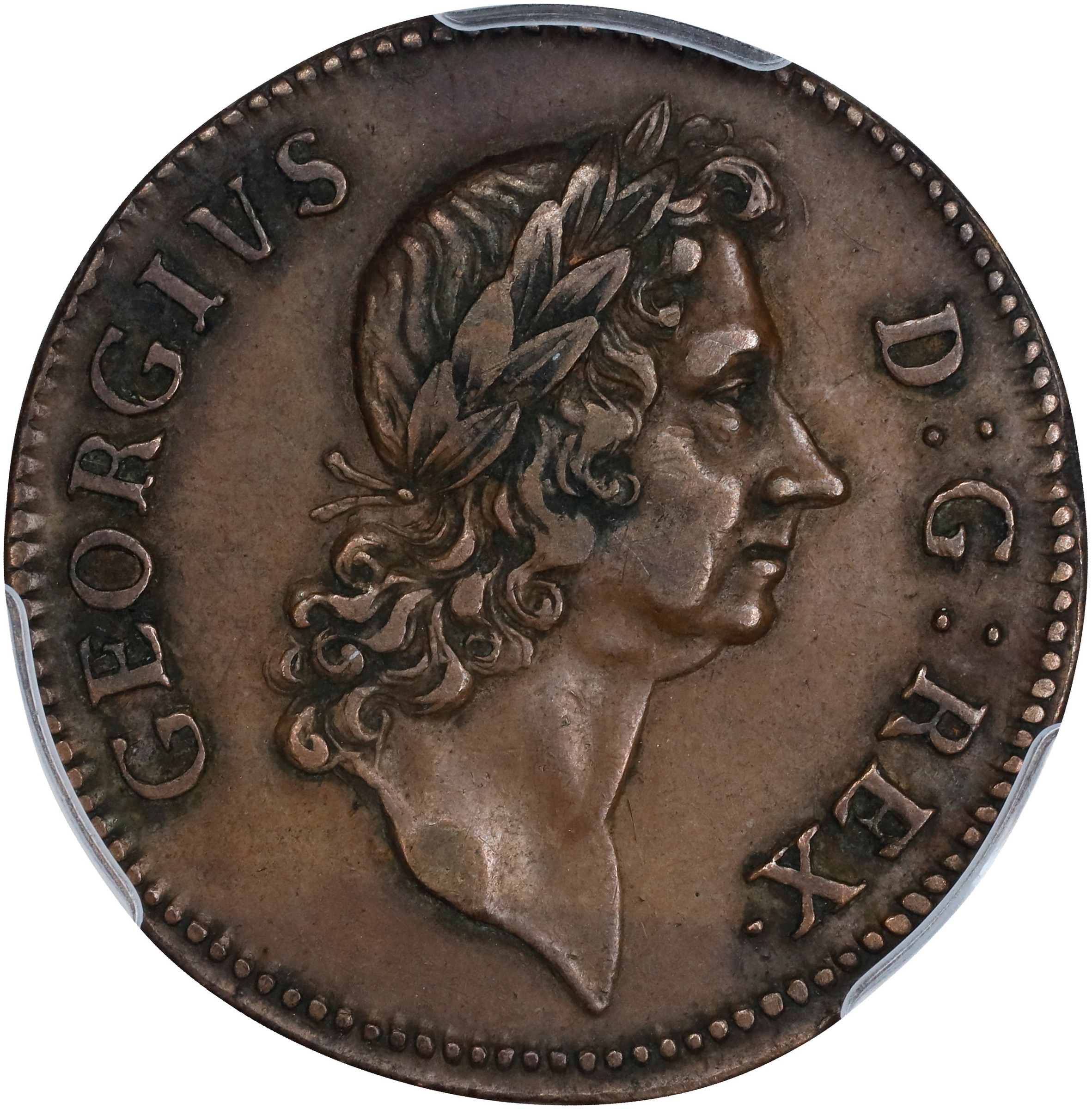
1722 1/2P Hibernia, Rocks Right, BN MS (PCGS#164)
Summer 2026 Global Showcase Auction U.S. Coins
- Auctioneer
- Stack's Bowers
- Lot Number
- 1315
- Grade
- AU50BN
- Price
- 9,760
- Lot Description
- A highlight of the present sale, the offered Wood's Hibernia pattern halfpenny is toned in original autumn-orange brown with overlying olive-russet clinging to the peripheral letters and within King George's hair on the obverse. The latter is associated with some light, ancient build up, but no troublesome marks are present to surfaces that present as impressively smooth during in-hand viewing. A nicely centered and visually appealing example of this rare and famous pattern type that features rocks to the right of the seated Hibernia figure on the reverse. Choice for both the type and assigned grade, and sure to see spirited bidding.<p>The obverse of this pattern type features a laureate bust of King George I facing right, the neck unusually long, with the legend GEORGIVS D : G : REX around the border. On the reverse, Hibernia is seated facing the viewer, playing a harp to her right, with her head turned toward an extensive rock formation in the right field. The harp has eight strings. The word HIBERNIAE flanked by stops is inscribed along the upper left border, while the date 1722 is in exergue below the seated figure.<p>Martin 1.1-A.1 is the only known die marriage of this type, and it is a significant numismatic rarity. As of our (Stack's) cataloging for Ford VII, January 2005, we were aware of only 12 distinct specimens. Aside from the primary Ford coin, described as "the finest seen," the best offered in recent memory was the PCGS AU-58 from our 2013 Craige sale. It later was recertified as PCGS AU-58+ and more recently sold for $14,687.50 in Heritage's August 2017 Denver ANA Signature Auction. Most are in the VF range, and we've even handled a holed VG, which observations help to distinguish the present example as one of the finest extant.<p>William Wood's coinage for Ireland, known as Hibernia, was authorized by royal patent dated June 16, 1722, and confirmed by the House of Commons on July 22 of that year. Coinage may have commenced in 1722, as several varieties of halfpenny are known bearing that date, including the rare Rocks at Right pattern represented here. Full scale production took place in 1723 and 1724, after which coinage ceased and Wood resigned his patent. His farthings and halfpence were the best made and most attractive coppers struck for the Emerald Isle to that time, but the coinage was rejected by the Irish because neither the Lord Lieutenant of Ireland nor the Irish Parliament had been informed about Wood's royal patent or its confirmation by the English House of Commons. Due to these political and personal considerations Wood's Hibernia coinage passed from circulation in Ireland within a decade or two of its issuance. Some examples found their way to the American colonies, as confirmed through excavations of various sites but, strictly speaking, Wood's Hibernia coins are Irish, not American. On the other hand the coins' association with Wood's Rosa Americana pieces, along with the aforementioned ground finds, have long made the Hibernia coinage an integral part of colonial and early American collections. Given the rarity of this pattern type and the infrequency with which examples appear on the market, the advanced specialist would be wise to take full advantage of the present offering.