1821 50C PR(PCGS#6196)
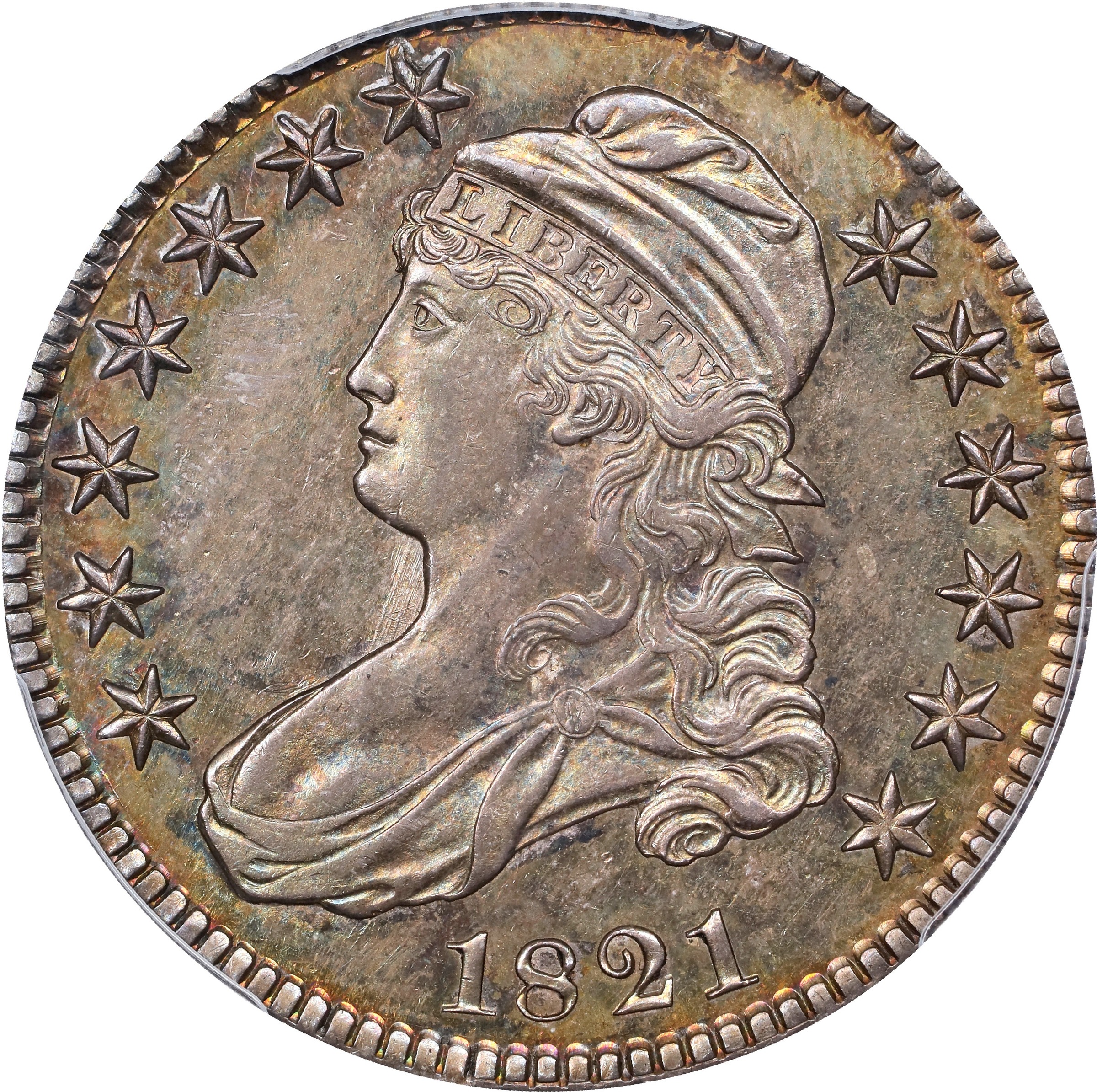
1821 50C PR (PCGS#6196)
Summer 2026 Global Showcase Auction U.S. Coins
- Auctioneer
- Stack's Bowers
- Lot Number
- 2090
- Grade
- PR63
- Price
- 85,400
- Lot Description
- A landmark offering, this is only the second confirmed Proof striking from the 1821 Overton-104 dies. Before our offering of this coin, only a single example of this variety had gained widespread acceptance as a Proof: the amazing "Colonel" Green-Newman specimen that, as NGC Proof-65, realized $52,875 in our September 2015 sale of the D. Brent Pogue Collection, Part II. That is the only Proof 1821 O-104 half dollar listed in both the 2025 Dannreuther census (<em>United States Proof Coins, Volume III</em>) and the Spring 2026 Herrman census (<em>Auction & Mail Bid Prices Realized for Bust Half Dollars: 1794-1839</em>).<p>In the 1989 edition of his <em>Encyclopedia of United States and Colonial Proof Coins</em>, however, Walter Breen reported the coin sold as lot 1096 in Abner Kreisberg's January 1975 sale of the John A. Beck Collection as a Proof 1821 O-104 half dollar. Whether or not the present example is the Beck coin is unknown as plate matching is not definitive. Regardless, in its PCGS Proof-63 holder this coin is a newcomer to the modern census for Proof strikings from these dies. It is an impressive specimen that exhibits all of those special qualities that distinguish true Proof Capped Bust, Lettered Edge half dollars from their Prooflike Mint State counterparts. The fields are deeply mirrored and the devices struck up in virtually every minuscule detail. A few of the high points are a tad soft, not unusual for a Proof silver coin of this era, and most noticeable on the reverse scroll at the letters UR in PLURIBUS (a characteristic noted for the Beck coin). Neither obverse nor reverse shows any frost or cartwheel luster. Lovely old toning in olive-orange copper iridescence is backlit by reddish-gold, powder blue and pinkish-rose shades; it obscures some light hairlines, but this piece shows few contact marks of consequence and has clearly been well handled since its moment of mintage. There is a batch of strong die lapping lines clinging to Liberty's throat, a feature also seen on the "Col." Green-Newman-Pogue specimen. A concentration of short, light scratches at the top of Liberty's bust is only readily evident under magnification, but still serves as a useful identifier for provenance purposes.