1850 $10 Baldwin & Co. MS(PCGS#10028)
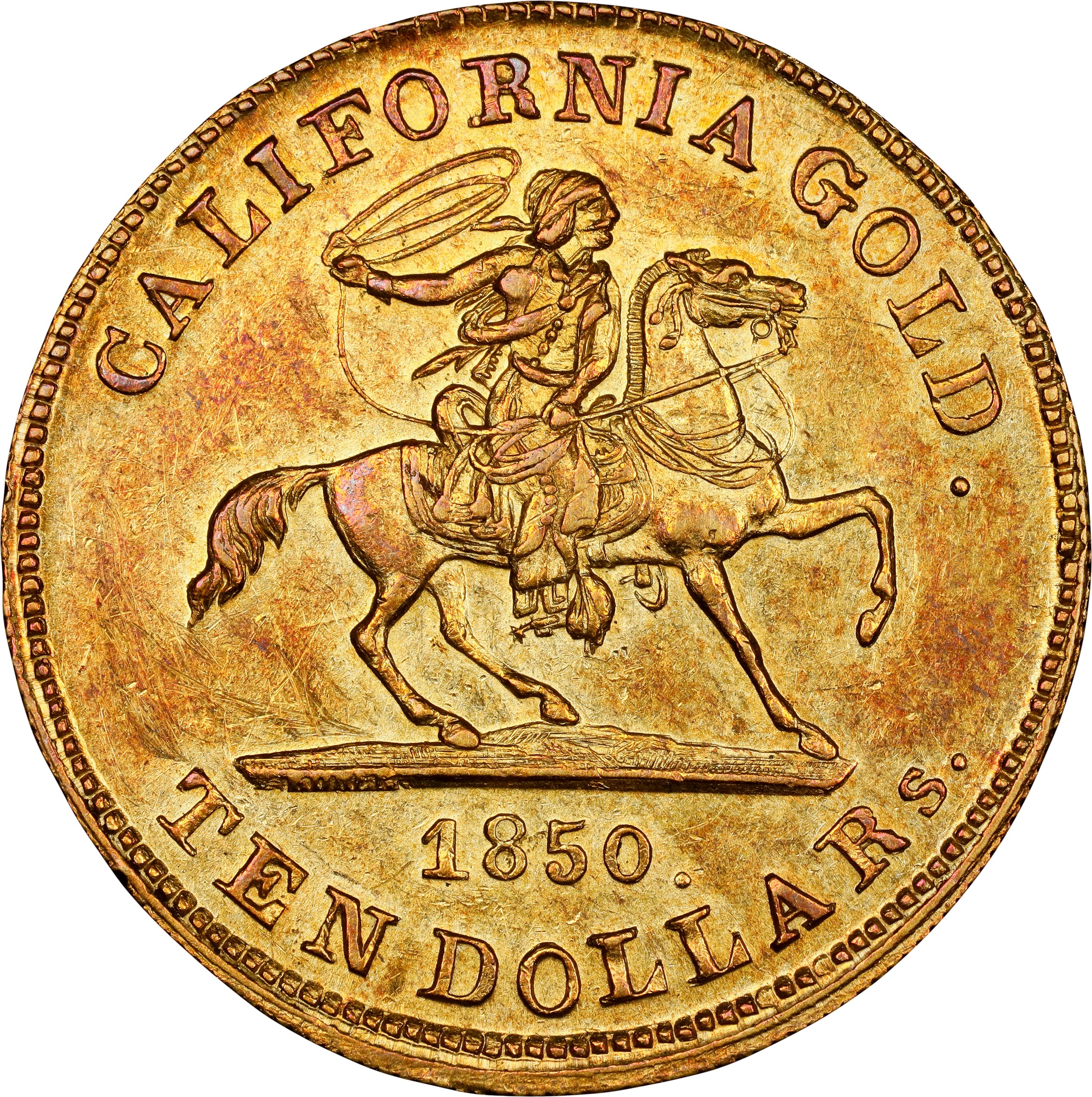
1850 $10 Baldwin & Co. MS (PCGS#10028)
February 2026 Showcase Auction - The James A. Stack, Sr. Collection Part II
- Auctioneer
- Stack's Bowers
- Lot Number
- 23062
- Grade
- MS61
- Price
- 840,000
- Lot Description
- A truly remarkable survivor of this coinage, featuring perhaps the most iconic design in the entire realm of private and territorial gold issues. Fresh and beautifully lustrous surfaces show intense cartwheel and light reflectivity on both sides. A blush of coppery toning over the fields of both sides enhances the magnificent visual appeal. Vestiges left by the hand-made production of this piece show the level of care the coiners took. A lintmark right of D of GOLD on the obverse indicates that the dies (and, perhaps, the planchets) were polished before striking. The alignment of the obverse, slightly aligned to 12 o'clock with the die edge visible at the base of that side, is a different direction than that seen on the reverse, which shows the die edge at upper left, suggesting that these pieces were struck somewhat crudely, likely with the planchets placed individually by hand rather than being machine fed. Further, doubling within the denticles on both sides indicates that more than one blow was required to bring these designs up to full detail, evidence of concern but also a good reason to abandon this design in favor of the Liberty Head device used by Baldwin in 1851 (acceptance in the marketplace was probably another). We see a single thin hairline scratch from the horse's mouth to the base of L in GOLD and a series of marks and abrasions at the left end of the obverse exergue below the horse's tail. Without these, this piece would have likely graded two points higher. On the reverse, extensive raised die finish lines are seen throughout the fields, though most prominently around the wing at right. These die finish lines are seen on all high grade specimens and should not distract, though very careful scrutiny does find some hairlines between the arrows and that wing that intermingled with the as-struck raised lines. The design elements are abundantly detailed, the fields are lively and original, and rims are intact, and the color is superb. This is a simply wonderful example. <p><p>In a landscape of designs that largely echo Federal types, mostly amateurishly rendered at best and downright crude at worst, Baldwin's "Horseman" $10 stands out. If it was only a rarity, the coin would still see abundant demand, but the distinctiveness of its designs make this type among the most famous and avidly sought of all California gold pieces. The obverse was inspired by an 1831 print entitled "Californians Throwing the Lasso," published in <em>Narrative of a Voyage to the Pacific and Beering's Straight</em> by F.W. Beechy after a watercolor by William Smyth. The print, and engraver Albrecht Kuner's fine imitation of it, show the typical dress of a <em>vaquero</em> or horseman in Spanish California, the original American cowboys and the etymological origin of the slang "buckaroo." (For a real rarity, try to find a copy of the <em>Numismatic Perspective</em> #2, published in July 2003 by American Numismatic Rarities, where this connection was first published.)<p><p>The Baldwin & Company firm rose from the ashes of the coining concern behind the Miners' Bank $10 coins of 1849. Frederick D. Kohler, a New York jeweler, was trying his hand at the assaying trade. Kohler's career was ascendent in 1850, as were his aspirations, and he planned to issue coins in his own name struck from dies engraved by Kuner. Just a single copper pattern of Kohler's Horseman $10 survives, struck from the same obverse as the coin seen here. His plans were aborted, and he sold his business to a pair of fellow New York jewelers named Baldwin and Holman. This fine (and, no doubt, expensive) obverse die was sold with the business, and the newly formed Baldwin & Company employed it on a short run of gold $10 coins sometime after April 1850. The first example reached the assayers of the Philadelphia Mint shortly thereafter, and Eckfeldt and Du Bois determined that the example of this coinage they tested contained $9.96 worth of gold. <p><p>Researcher Saul Teichman has assembled a census of 22 examples, a few of which may be duplicate entries. Two of the coins listed are impounded at the Smithsonian, and a circulated piece is listed that was stolen from Yale in 1965 and has not yet been recovered. Kagin and McCarthy estimated "between 20 and 25 examples exist in private hands." Many of these are quite high grade, led by the Bass gem graded MS-64+ (PCGS), but few can boast the originality, color, and eye appeal of this one.<p><p>When B. Max Mehl had a chance to describe this coin, he called it a "beautiful uncirculated specimen with full mint luster" of an issue that was "excessively rare and of highest numismatic and historic interest." Even almost 80 years ago, it was "one of the most popular and sought-after pioneer gold coins." Its distinctiveness and the iconic symbolism of California's early cowboys have made this issue a prime target for many collectors who care little for a collection full of imitations of Federal gold designs. This is a standout specimen of a standout rarity, an issue that captures the spirit of Gold Rush California like no other numismatic collectible.