1803 $10 Small Reverse Stars MS(PCGS#8565)
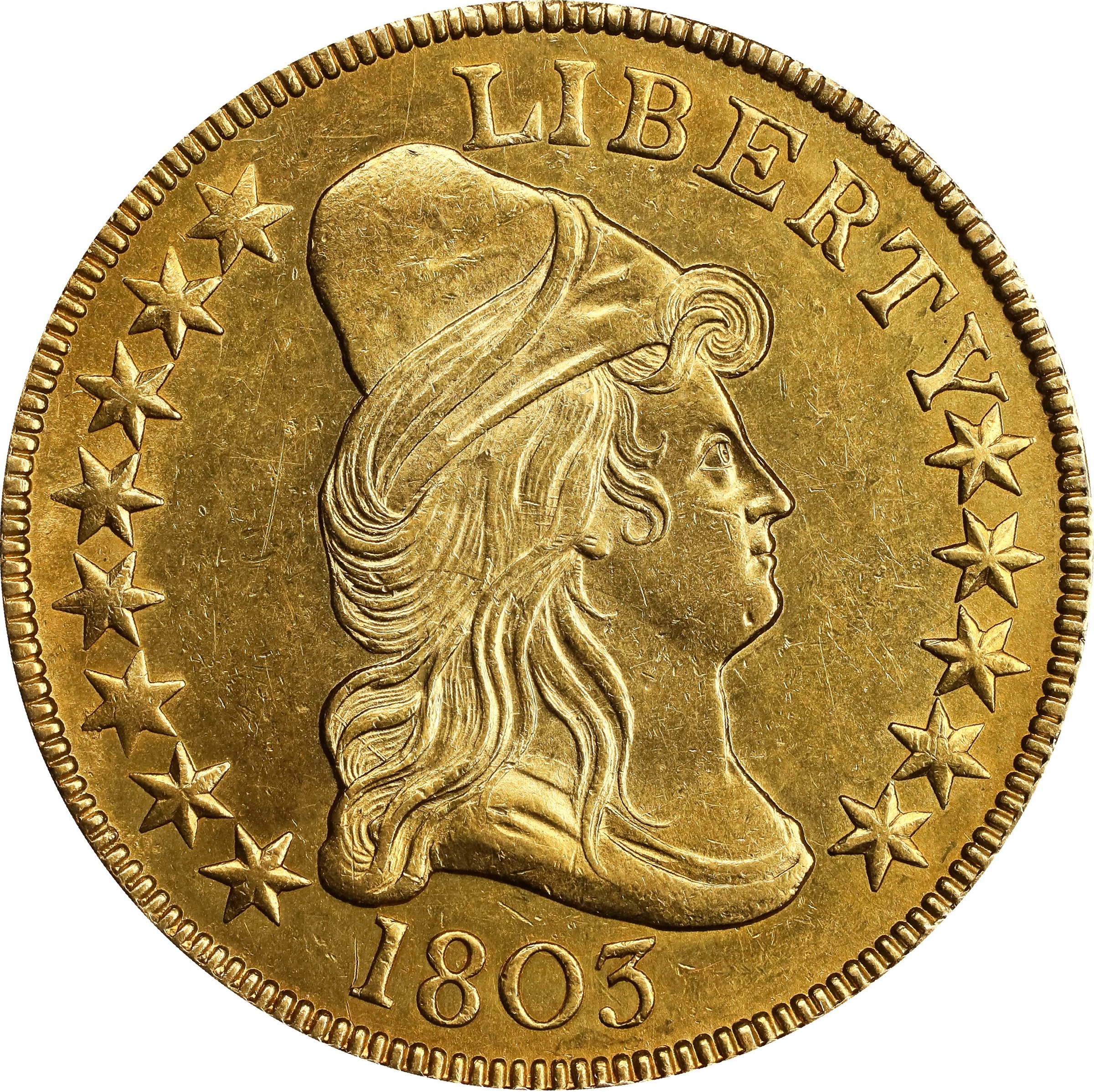
1803 $10 Small Reverse Stars MS (PCGS#8565)
Spring 2026 Showcase Auction U.S. Coins
- 경매인
- Stack's Bowers
- 로트 번호
- 3146
- 등급
- MS62
- 가격
- 36,000
- 로트 설명
- BD Die State c/d. An attractive Mint State example of this challenging early gold type, with deep olive undertones to dominant medium golden color. Sharply struck by early U.S. Mint standards, Liberty's portrait is bold on the obverse and the eagle's feathers on the reverse are crisply delineated throughout. Tinges of softness are noted along the left obverse border, affecting several of the stars and also manifesting on the reverse at the eagle's right talon. A few light adjustment marks (as made) are evident at upper left and lower right reverse, but as these are out of the way at the borders they are easily overlooked in most viewing situations. The texture is frosty, and while a tad bright, there are only wispy handling marks that do not detract.<p>The eagles coined in 1803 offer a fascinating insight into the difficulties the early Mint confronted with coin production. Only a single 1803-dated obverse die was hardy enough to produce the entire output of eagles, but the six different reverse dies tell a different story. The first two reverse dies for this issue seemingly did not last very long, producing between 1,800 and 3,100 coins between the two of them. Mint personnel then resurrected an 1801 reverse die to produce the BD-3 die pair, one that at least was able to coin some 7,500 to 10,000 eagles before it, too, failed. It is uncertain what precisely led to its failure as a terminal die state is not presently known, but the strong clash marks and evidence of heavy die lapping on the reverse to remove an earlier series of clash marks would tend to indicate that withdrawal from use was likely imminent by the time these last few coins were produced from this die pair.<p>As with other early gold issues, the precise mintage is a matter of conjecture. The widely accepted and most quoted figure is that 15,017 pieces were struck in 1803 divided between 8,979 Small Reverse Stars and 6,038 Large Reverse Stars coins. The die sequence analysis by John Dannreuther points to a larger quantity somewhere in the range of range of 13,850 to 20,450 specimens because the original estimate fails to take into account a later batch of eagles struck in 1804, using a backdated 1803 obverse. The BD-3 variety has long proven to be the most available of the six die pairs with as many as 200 individual specimens in existence, though one should be cautious to apply the word "common" to any early gold eagle, as the mass meltings in later decades took a very heavy toll indeed. A modest number of Mint State examples exist for numismatists to appreciate, though this is an issue that becomes increasingly challenging the higher up the grading scale one progresses.