1794 50C MS(PCGS#6051)
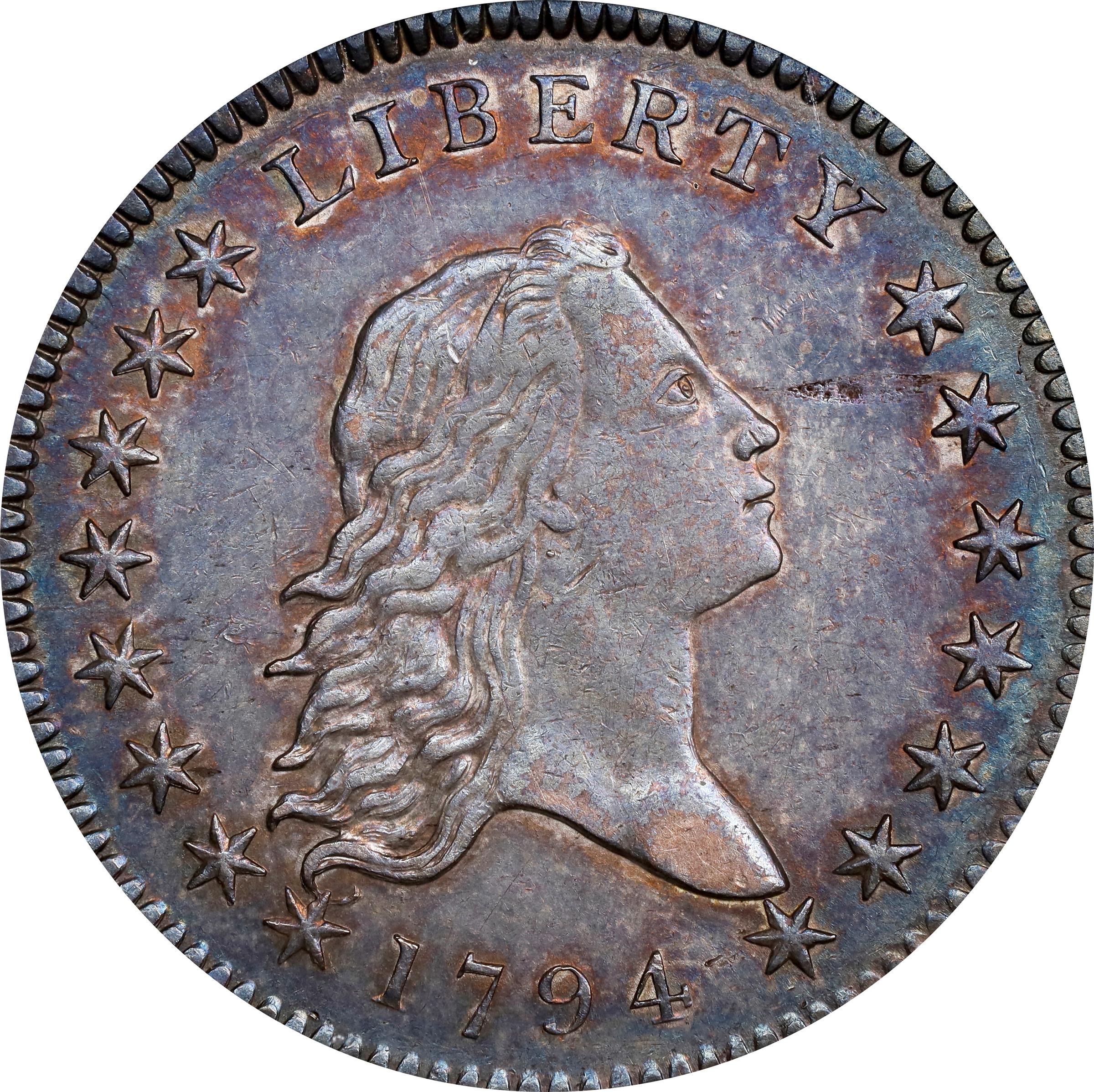
1794 50C MS (PCGS#6051)
February 2026 Showcase Auction - The James A. Stack, Sr. Collection Part II
- 拍卖行
- Stack's Bowers
- 批号
- 25069
- 等级
- MS61
- 价格
- 156,000
- 详细说明
- Tompkins Die Stage 1/3. Offered is one of the finest, and few known Mint State examples of this historic key date issue in the early half dollar series. It is a handsome piece, warmly toned in dominant pewter gray and olive-russet patina. Direct lighting calls forth vivid undertones of cobalt blue, lilac and pinkish-apricot from the obverse, even more vivid colors of reddish-apricot and steel-blue from the reverse. Both sides are ideally centered within fully denticulated borders, the detail generally sharp for the type, but softened somewhat at the top of Liberty's head and through and around the eagle's legs with a concentration of crisscrossing adjustment marks (as made) in the latter area. The adjustment marks join a shallow planchet drift mark (also as made) in the right obverse field, off Liberty's nose, to readily confirm this coin's provenance. Softly frosted luster shines forth nicely as the surfaces rotate under strong lighting. A tiny reverse scuff between the letters ED in UNITED is noted, but otherwise there are no post-production blemishes to report, the in-hand appearance impressively smooth for both the type and the assigned grade.<p>While today the half dollar is seldom seen in circulation and offering one up in change will often generate odd looks and questions, it is only relatively recently that this has been the case. Half dollars have traditionally been "workhorse coins intended for use in the channels of commerce," as Q. David Bowers described them. The reduction in the required surety bonds for the chief coiner and the assayer so that production of precious metal coins could commence came late in 1794 and in this first year, 23,464 (or fewer) pieces were made, as opposed to a much larger delivery of 299,680 pieces for calendar year 1795. Mintages plummeted thereafter and remained limited until 1805, as the silver dollar took precedence among bullion depositors in need of a large coin for domestic financial needs and use in the export trade. After the federal government halted production of the latter in 1805, the half dollar quickly established itself as the denomination of choice among silver bullion depositors, a situation that would continue well into the 19th century.<p>Of the 11 known die marriages of the 1794 half dollar, O-101 is the most frequently encountered. This is not to imply that this is a common variety, for the 1794 as an issue is scarce to rare in all grades, irrespective of die marriage. The first half dollars struck in the United States Mint were 5,300 examples delivered on December 1, 1794. All of these coins are assumed to have been struck from 1794-dated dies. The <em>Guide Book</em>, among other numismatic references, provides a mintage figure of 23,464 pieces for this issue, as above, which assumes that the 18,164 half dollars delivered on February 4, 1795, were also coined from 1794-dated dies. This is conjecture, and we will never know for certain whether the coins delivered on February 4, 1795, were dated 1794, 1795, or both. Based on the number of die marriages known for the 1794-dated issue, as well as the number of coins extant, it is likely that at least some of the coins delivered in early 1795 were from 1794-dated dies. We suspect that the actual mintage for this issue is somewhat less than 23,464 pieces, most of which have long since been lost to commercial use.<p>The 1794 O-101 half dollar is conditionally challenging, with the vast majority of survivors well worn in grades such as VG, Fine and VF. The Condition Census as given in the 2015 reference <em>Early United States Half Dollars, Volume 1: 1794-1807</em> by Steve M. Tompkins reads: 64, 63, 61, 61, 61, 58, 58. The Dean Oakes Family specimen is one of the MS-61 coins, and it is listed as tied for CC#2 for the early O-101 die state in the Autumn 2025 revision to Stephen J. Herrman's <em>Auction & Mail Bid Prices Realized for Bust Half Dollars: 1794-1839</em>. The CC#1 coin for the 1794 O-101 attribution is the Jimmy Hayes coin that has not appeared in the market since 1985; the Pogue PCGS/CAC MS-64+ is from the O-101a die state, as is the Hawn-Queller coin in MS-63.