(1849) $10 Miners' Bank MS(PCGS#10236)
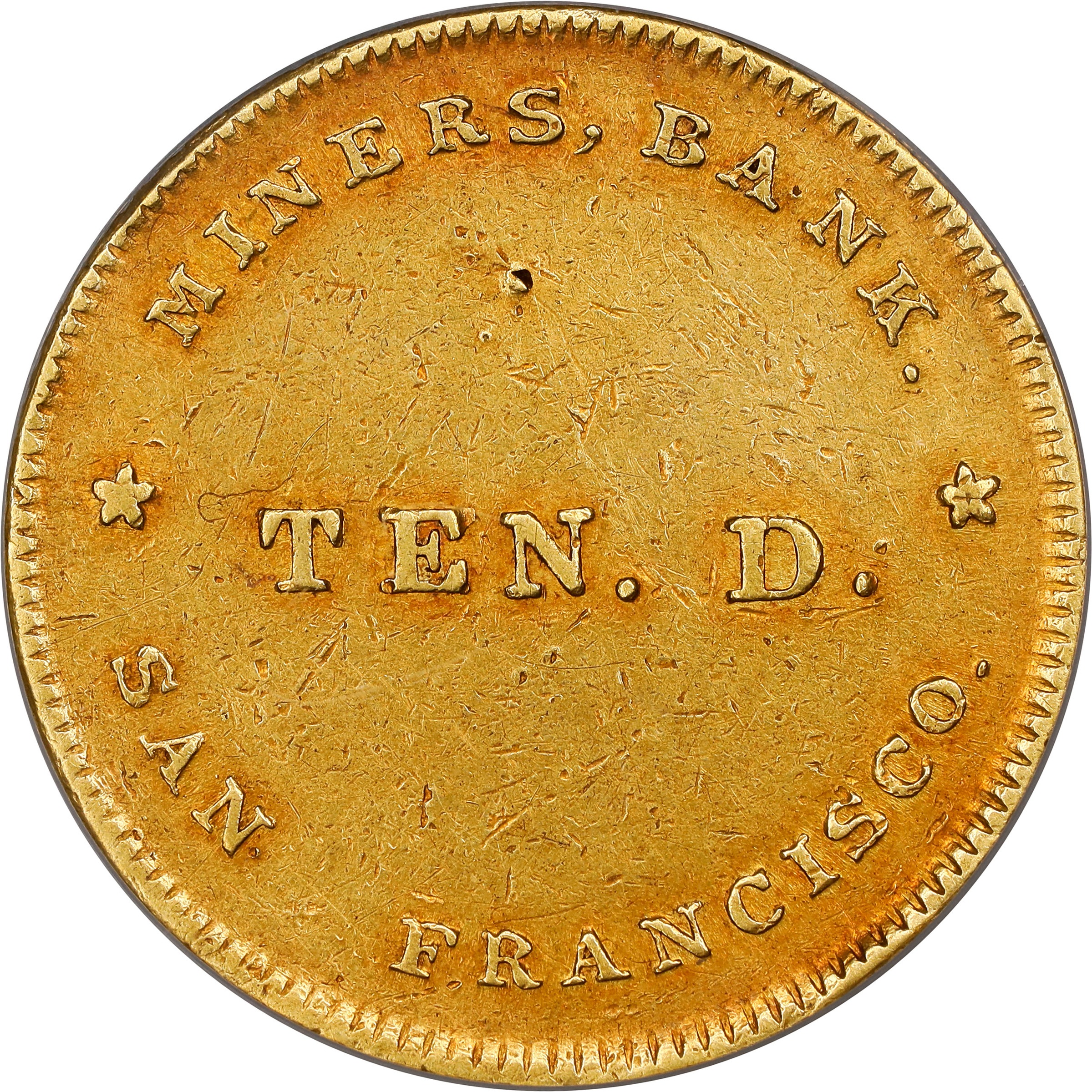
(1849) $10 Miners' Bank MS (PCGS#10236)
Summer 2026 Global Showcase Auction U.S. Coins
- Auctioneer
- Stack's Bowers
- Lot Number
- 2621
- Grade
- XF40
- Price
- 134,200
- Lot Description
- Rare and highly desirable premium Extremely Fine quality delight the viewer of this elusive Territorial type. This coin exhibits handsome deep honey-orange gold color enhanced by rose-gold patina that finds greatest concentration in the protected areas around the design elements. Universally sharp in strike, both sides show only minimal high point wear that suggests that an AU grade would not be inappropriate here. The texture is satiny with traces of original luster also discernible. Lightly to moderately marked from commercial use, not at all unusual for a circulated privately issued coin from the California Gold Rush era, and a tiny nick in the expansive upper obverse field area is the only singularly mentionable mark, and useful as an identifier for provenance purposes. The eye appeal is outstanding for a Miners' Bank $10, especially at the EF-40 grade level assigned on the Generation 3.0 PCGS insert.<p>One of the early banking concerns of San Francisco, the Miners' Bank was established by the brokerage firm of Wright & Co., headed by partners Stephen Wright, Samuel Haight, James Wadsworth, and John Thompson. Many details are scarce including precisely when both the bank and the brokerage firm commenced business, something made especially difficult considering the various other enterprises in which the partners were engaged at the same time. Intriguingly, an issue of bank notes issued by the Miners' Bank is known dated March 1, 1849, predating California's constitutional prohibition against currency as ratified in November of that year. There is doubt as to whether or not some of these notes were legitimately ordered by Wright from New York printer Danforth & Hufty. While some of the $1 notes appear to have been issued by Wright and Haight and saw circulation, other denominations including the $3, $5, and $10 notes are often found falsely filled in.<p>It was not until July of 1849 that the Miners' Bank officially announced that it had opened its doors to business at its location on the corner of Washington and Kearney Streets. Evidently the firm had planned an issue of gold coins early on because the next month, they petitioned the Collector of the Port of San Francisco to grant permission to issue $5 and $10 coins in payment of import duties, even though the Customs House would not accept such pieces. Even though their petition was denied, the Miners' Bank went forward with the striking of coins in hopes to alleviate the specie shortage of the region as well as make a small profit. Because the bank did not have their own assay and refining equipment on their premises, the coins were struck at a different facility, most likely by the assay firm of Broderick & Kohler based on the testimony of James Wadsworth at a trial in which Broderick & Kohler were defendants where Wadsworth states that they produced the coins for the Miners' Bank. Only the $10 coins were made, which circulated widely at first. By October 1849, examples were reported in New Orleans and on the East Coast, while by early 1850 Miners' Bank coins had even made it as far as Auckland, New Zealand.<p>Things changed, however, when the assayer for the New Orleans Mint examined a Miners' Bank $10 coin and found it was significantly underweight and worth only $9.65. The news spread quickly and, in any event, coinage ceased in late 1849, after the partnership between Broderick and Kohler dissolved, the former then serving in the California Senate as representative for San Francisco county. In April of the following year the <em>Daily Alta California</em> reported that, "The issue of the Miners' Bank is a drug on the market. Brokers refuse to touch it at less than 20 percent discount." As with many of the first of the privately issued territorial gold coins, large numbers of the coins later ended up in the melting pots of the United States Assay of Gold, and not long after that those of the San Francisco Mint. The few remaining specimens are in perennial demand by connoisseurs of the historic California Gold Rush era and considering the overall excellent state of preservation of the present piece, one can expect spirited competition.