1861-D G$1 MS(PCGS#7559)
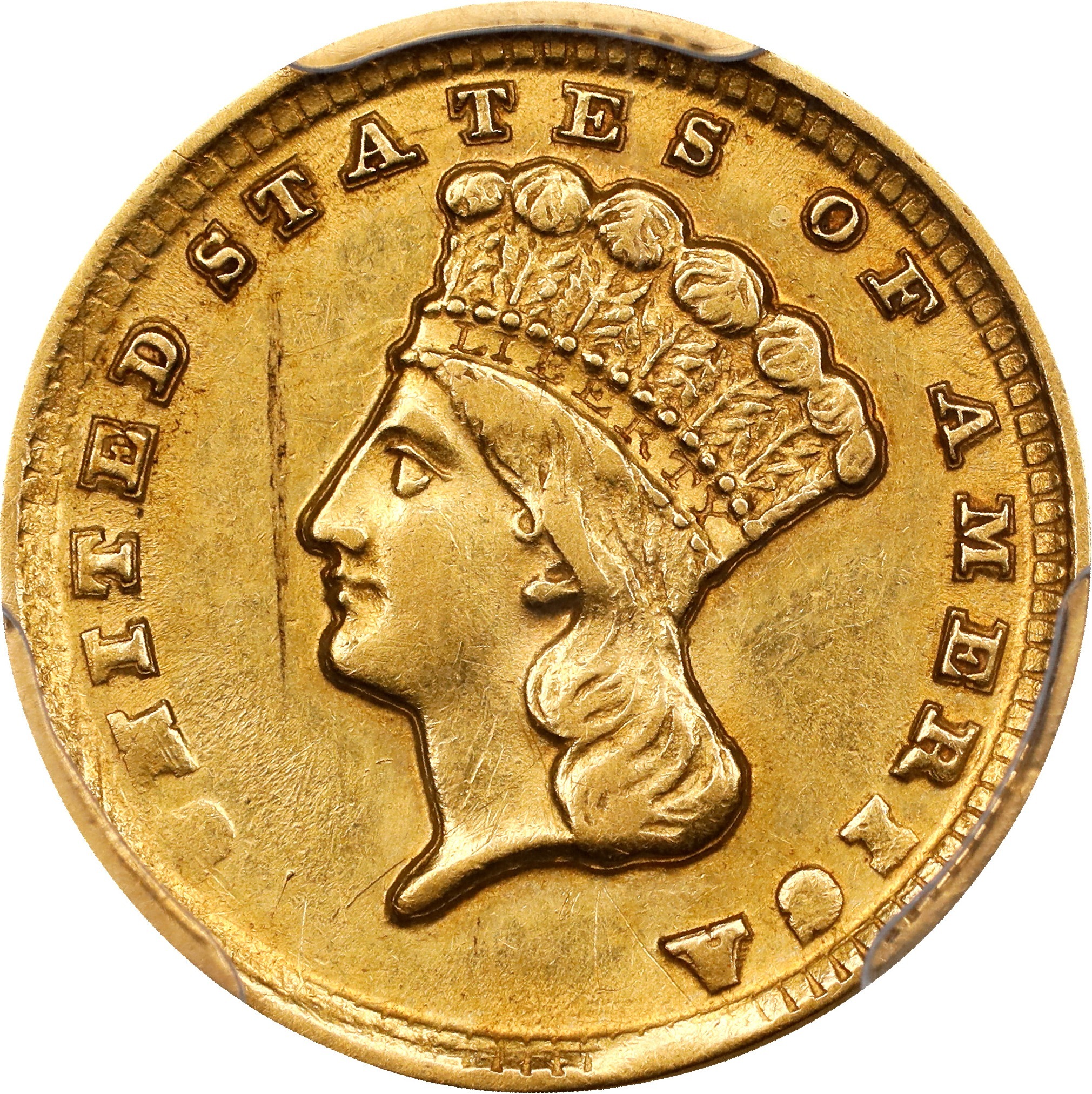
1861-D G$1 MS (PCGS#7559)
Summer 2026 Global Showcase Auction U.S. Coins
- 경매인
- Stack's Bowers
- 로트 번호
- 2192
- 등급
- AU53
- 가격
- 67,100
- 로트 설명
- Outside of the virtually-uncollectible 1849-C Open Wreath, the 1861-D is the undeniable star of the gold dollar series, and perhaps one of the most intriguing issues to ever emerge from the Dahlonega Mint. By the brink of the 1860s the American political climate was in a state of chaotic volatility. Outraged over Lincoln's victorious presidential campaign, the legislature of South Carolina voted to secede from the Union on December 20, 1860, initiating what would be a furious cascade of secessions over the following months. Amidst this tumultuous atmosphere, two pairs of gold dollar dies were sent from Philadelphia south to Dahlonega in December of 1860, arriving on January 7th, 1861 in anticipation of a full production year. However, this would be the last time dies would cross the Mason-Dixon en route to Dahlonega, as Georgia would sign the Ordinance of Secession just twelve days later, becoming the fifth state to secede from the Union. When the state joined the Southern Confederacy in February, Dahlonega Mint Superintendent George Kellogg and his staff transferred their allegiance to the new government.<p>Sometime on or after March 1, 1861, the staff at Dahlonega utilized the remaining bullion on hand to strike approximately $3,000 face value worth of coinage divided between gold dollars and half eagles. A small quantity of half eagles had been produced at Dahlonega prior to Confederate occupation, though the gold dollars struck by rebel technicians represent the only examples to be struck of the issue. This gives the 1861-D gold dollar the distinction of being the only coin to be struck exclusively by the Confederacy, as the 1861-O half dollar, 1861-C and 1861-D half eagles, and 1861-O double eagle all have Federal analogues.<p>Overall production quality for the 1861-D gold dollar was dreadful, and this despite the experience of the existing staff and the supposed availability of fresh dies from Philadelphia. An obverse die was reemployed from the previous year, and the inadequacies of this fatigued die contributed to a profound weakness at the lower obverse periphery on all pieces, with the letter U in UNITED completely obliterated at times. While the reverse is typically more presentable, it too is plagued by peripheral softness that obscures the denticulation on many examples.<p>The Dahlonega Mint was soon after converted to an assay office by the Confederate Congress on August 24, 1861, and went on to be used for academic purposes in the following decades, though it never again struck even a single coin. As the Civil War's numismatic bastard child, the 1861-D gold dollar is truly one of the most significant issues to come from an American mint.<p>Scholars traditionally estimate that approximately 1,000 to 1,500 gold dollars were struck, with more modern research by Carl Lester suggesting an even lower number of 500 pieces, according to assay records. Of that figure, just 70 to 100 pieces are thought to exist today. Curiously, this extant population is largely composed of well-preserved pieces, with a particular concentration to be seen in About Uncirculated grades. This suggests that they were perhaps saved as souvenirs, or points towards the existence of a small hoard, though in true Mint State this issue is a fabled treasure.<p>This desirable About Uncirculated rarity is bathed in rich honey-orange and more vivid rose-gold colors. The design elements are haloed by soft mint luster, with significant, frosty concentrations looming in the recessed areas. Fairly smooth and well-composed for the assigned grade, we note only wispy handling marks that are easily overlooked in hand, as well as a more noticeable, although as made vertical streak in the left obverse field. Characteristic weakness is apparent to the aforementioned regions, with the letter U in UNITED nearly obscured and portions of the reverse wreath removed by die polishing. Despite these oversights in workmanship, the complexion is one of delight. It is wholesome and warm, rich with hue and luster that is only enhanced by the incredible narrative of the overall issue. This coin is a true national treasure and certainly a significant find for Southern gold and Civil War enthusiasts.